
Return as a Voluntary BJV Subscriber!
By Albert Stern / BJV Editor
Most of you reading this annual appeal for voluntary subscribers will be doing so in the late summer run-up to the High Holy Days, traditionally a time of reflection about our deeds over the past year and our aspirations for the next. In Hebrew, the process is called teshuva, which can mean repentance but that literally translates as “return” – a return, we hope, to paths of righteousness already familiar to us.
As I do each year, I look over the past year’s papers so I can remind readers and supporters of the Berkshire Jewish Voice of some the stories we hope you enjoyed. This year, I noticed that the idea of return cropped up over again in various ways, some of which will be apparent and some that are more specifically personal. But before I get there, let me return to some BJV boilerplate that we’ve used for years when asking you to support your local Jewish community newspaper with an additional gift to Federation.
This publication’s revenues do not cover all its costs. Your financial help as voluntary subscribers is essential in our efforts to bring you meaningful, positive, and entertaining stories both by and about your neighbors, as well as about Jews around the world. Your generosity as voluntary subscribers last year was phenomenal, and your support remains vital to sustaining this publication. Please see the insert in this paper or look out for the email you’ll soon receive from Federation for more on how you can support the Berkshire Jewish Voice.
For me, the most exciting return was my trip to Israel last February. In our April issue, I wrote about my visit to our Afula-Gilboa Partnership2Gether region perhaps too enthusiastically. About that article, no doubt many readers felt as Samuel Johnson did about Milton’s Paradise Lost: “None ever wished it longer than it is.” And what you read was only Part II – I haven’t even gotten to Part I yet. It had been 15 years since my last visit to Israel, where I spent a meaningful part of my childhood, including two years of conflict during the Yom Kippur War that started in 1973. Being there, even as war approached, and seeing what Israel has become – and witnessing firsthand the good work being done in Afula-Gilboa with funds from this Federation’s annual campaign – my excitement was off the charts.
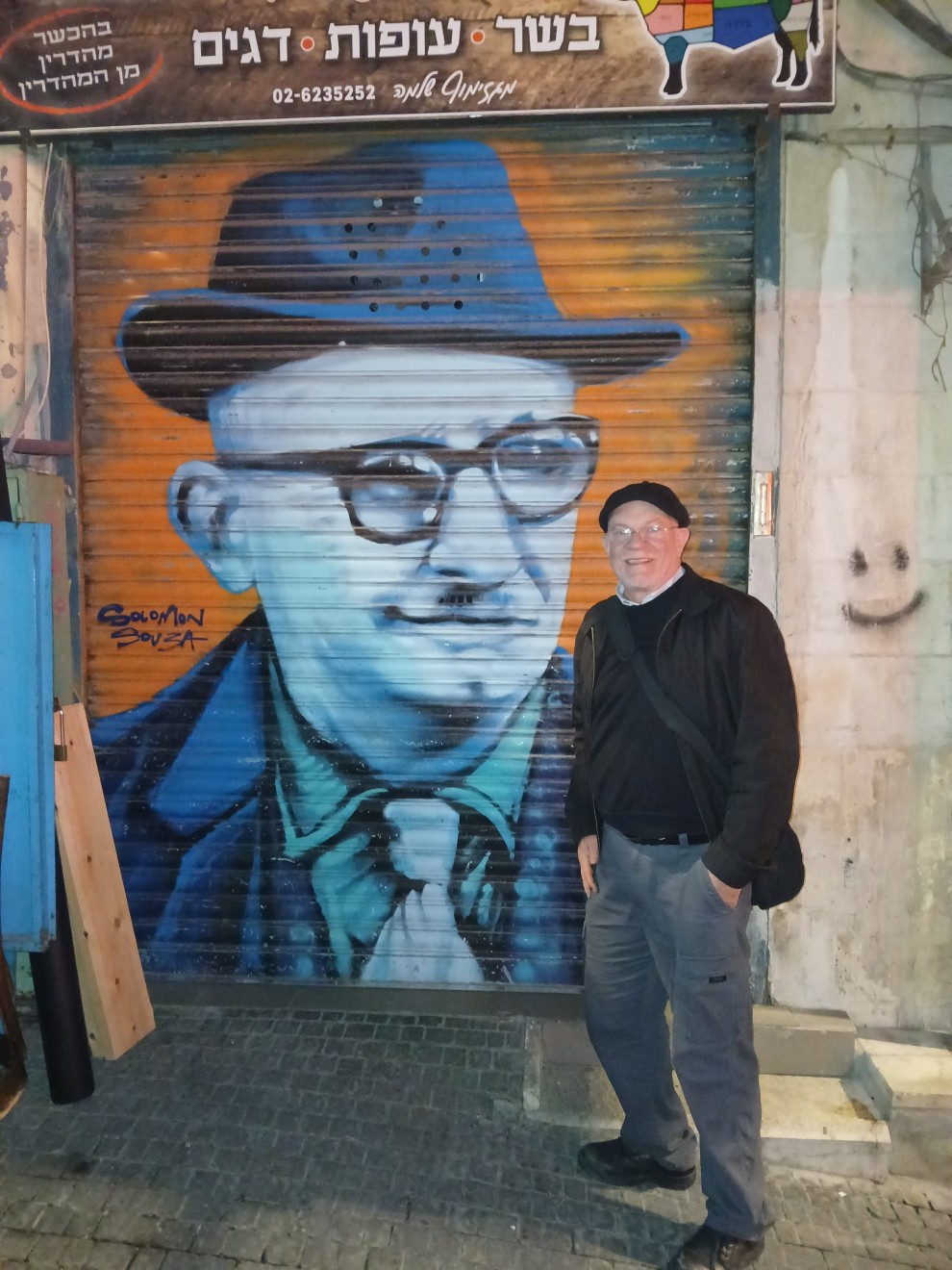
I will publish a Part I to that story somewhere, eventually, but let me share now that on my visit to Jerusalem, I was brought back to a story I published in my second year as BJV editor back in 2016 about the artist Solomon Souza. Back then, I discovered an online compilation of his graffiti-inspired art on the shutters that come down at night in the Machane Yehuda market. They mostly depict illustrious Jews of history, but some are of shopkeepers in the shuk – the one you see above is the one I wanted to visit most.
I was thrilled all the more a month or so later when Howie Stier posed in the same spot. I was lucky – I got home before the war with Iran started, unlike Howie, who wrote a vivid Berkshire Jewish Voices essay on hunkering down in the neighborhood miklat (bomb shelter) with his fiancé Revital and neighbors in the Nachalot neighborhood as Iranian missiles rained down. We try to provide original writing that gives our Berkshire audience as a better sense of life in Israel in these fraught times and how members of our community have engaged with the nation and its people. I was in awe of the harrowing stories told Ori Lazarovich, a young Magen David Adom (MDA) paramedic who spent part of his childhood here in Lanesborough and who is now a first responder to crisis spots across Israel. Another column we published was Dr. Gene Jura's account of his experience on a Sar-El mission with Jews and non-Jews from around the world that provided meals for nearly 24,000 IDF soldiers. Gene didn’t have a chance to take a picture with the mural of the guy with a hat at Mahane Yehuda, but we would have published it in the BJV if he had – and will if you take one when you visit Israel and send it in. It’s near the entrance of the shuk just off Jaffa Street.
I also returned to Jewish Federation’s General Assembly in Washington, DC, for the first time in ten years, a powerful immersion in how Jewish communal life, thinking, and priorities have changed in the wake of the October 7, 2023 attack and the global upsurge in antisemitism. I wanted to show that Jewish Federations are thinking clearly about the threats the community faces, physically in our communal spaces and houses of worship, as well as online, culturally, institutionally, and politically. I hope my reporting demonstrated that the system we are a part of is responding forcefully and intelligently to our challenges – Jewish Federations provide a unified countervailing force against the enemies of Jewish success, one that I am honored to work for and one that needs our support.
And I also had a chance to share how I was able to return home to places I’d never been before – houses built in Frederick, Maryland, and Essex County, Virginia, by two 6th great-grandfathers who were both Revolutionary War soldiers. On this 250th anniversary of the founding of our nation, I’m finding out more about my American roots and my adoptive family’s Eastern European story, and was helped along by two of the authors I interviewed this year – Professor Michael Hoberman, whose Imagining Early American Jews helped me sort out my impressions of my genealogical journeys, and Jane Ziegelman, whose remarkable meditation on yizkor books reconnected me with the memorial volume of the shtetl from which my maternal grandparents emigrated.
Connecting to that Eastern European story remains something of a challenge, as I expressed in one of the stories that included my visit to the Yiddish Book Center in Amherst. I had a chance to interview Susan Bronson, the new head of that vital repository of Jewish literature and culture, and share the story of how the YBC will be moving forward with “Yiddish: A Global Culture,” the permanent exhibition documenting the Ashkenazi world that flourished from the 1860s until the catastrophe of World War II. It’s a project that is as much forward looking as it is historical and will remain an essential resource in preserving a part of Jewish history that continues to shape contemporary Jewish life, self-image, and self-understanding. We are lucky to have it close by.
My interview with Susan was just one of the forward-looking stories we published. It was a pleasure to write about Rabbi Mendel and Zivia Volovik of Chabad of Williamstown, who are connecting with Williams College students and amplifying the opportunities for Jewish connection in the northern Berkshires. On the opposite side of Berkshire County, educator Lindsey Brown has partnered with Federation to expose the students at the Mount Everett school in Sheffield to anti-bias initiatives like Changemakers for Good and the MA Mobile Museum of Tolerance. Visiting the school for a performance of Shany Dagan's Holocaust-themed 3RDGEN dance (brought to the Berkshires by Shery Londe) and then some sessions with students in the MMOT brought home how Federation and our partners are reaching local youth with positive messages that are making a difference in their lives and our community.
Our Super Tzedakah Week chairs, Molly and Chris Meador, shared their story of how Federation has supported their family’s Jewish journey every step of the way, particularly with religious school and summer camp scholarships. Talking to them helped me, and I hope you, understand the challenges younger members of our community face in establishing and sustaining a career in the Berkshires and finding their Jewish peers, and how helpful Federation can be in outreach to connect folks who are working and raising families. Our Berkshire Jewish Collective is just one initiative to build and sustain a segment of our community that can often feel overlooked in a region that attracts more retirees than young adults. And it was also a pleasure to meet our future-focused Major Donors Celebration chairs Ken and Mimi Heyman, who explained the importance of legacy giving to ensure continuity in Jewish communities.
One of the upsides of living in a mature community is that our demographic still reads books. This year, I was fortunate for a second time to interview Andrew Porwancher, this time about Theodore Roosevelt's relationship with the Jews of his era. Dr. Steve Rubin’s columns provide useful appraisals of books of interest – if Dr. Steve says a book is worth reading, it surely is. Carol Goodman Kaufman – an accomplished novelist in her own right – interspersed her regular food articles with interviews of literary heavy-hitters Tova Mirvis and Marilyn Simon Rothstein, as well as an amusing tale of a set of 18th century tefillin found in Pittsfield. Israeli chiropterologist Yossi Yovel was a pleasure to talk to – I think about what I learned from him and his delightful and surprising book, The Genius Bat, on these warm summer evenings when I watch Berkshire bats fluttering overhead. David Kaufman took us back in time describing his photographic project The Posthumous Landscape: Remnants of Jewish Life in Eastern Europe, People sometimes tell me that they wish we had a podcast – this spring, we came close when my colleague Rabbi Daveen Litwin asked me to have host an online program with critic David Denby about his book Eminent Jews: Bernstein, Brooks, Friedan, Mailer. It was well-attended and many folks shared that they would like more like that.
The fact that so many of you all appreciate good writing emboldened me to publish verse by some very accomplished Berkshire poets: Richard Berlin, Rabbi Pamela Wax, and, in this issue, Adam Green. Our local rabbis also come through each issue with meaningful and well-crafted Rabbi Reflection columns. And my favorite piece of original writing we published this year was Alex Rosenblum’s hilarious reminiscence “My Life as an American Soldier” – to paraphrase Winston Churchill, never was so much owed by so many to Alexander Ziskin ben Moshe Yidel. Thank you, my friend and fellow Chabadnik, for your service and for your writing.
Let me wrap up with some additional BJV boilerplate we’ve used successfully on past voluntary subscriber appeals:
Please see the insert in this newspaper for the different funding levels available. An honorary publisher gift of $360 allows us to provide four pages of color. Due to popular demand, we are printing more copies of each issue and printing costs have escalated in recent years. Your support will allow us to reach more people wishing to connect with all our Jewish community offers to full-time residents, part-time residents, and the tens of thousands of Jewish vacationers who visit the Berkshires each year.
In these challenging times for the Jewish community, it’s always a relief to publish a positive story like Ruth Kaplan’s “My Divine Kiss by an Angel in the Berkshires.” While at Baker’s Golf Center playing mini-golf, a stranger named Angel spotted her necklace with a message of support for Gaza hostages in both Hebrew and English and expressed his affection and sympathy for the Jewish people.Over the last 12 months, all of us have read stories in which Jewish jewelry has elicited hateful responses, and Ruth’s story was reassuring in how it showed we are not as alone as we can sometimes feel. Kudos, as well, to Shakespeare & Company, whose artistic director Allyn Burrows shared the reasons that the group staged a Jewish plays festival last fall and will do so again this year. The arts world these days is often rife with cancelations of Jewish creators, and it was reassuring to hear from Allyn how our Berkshires arts institutions are refusing to accept that.
For the same reason, I have to thank our advertisers for their ongoing support of the Berkshire Jewish Voice. Yes, the paper offers much bang for their advertising buck, being read, valued, delivered to the homes of an attractive upscale demographic in Berkshire County. Advertising in the BJV should be a no-brainer for anyone wishing to publicize their programming or services, but as we’ve seen in recent months, in some places, $9 and being sitting US congressman cannot buy you a cup of coffee if you are Jewish. Read the article about Rachel Simons of Seed + Mill to find out how capriciously Jewish businesses, even those working cooperatively with Muslim Israeli Arabs, are being canceled
In ordinary times, taking out an ad in a Jewish newspaper would not be construed as a big deal. These are not ordinary times, and it is a big deal. I am grateful to the wider Berkshire community for supporting this newspaper and the Federation that publishes it.