
By Howie Stier / Special to the BJV
Just before the early morning dawn they tried to murder me – yet again. That is, myself and the thousands of Jews living in the Nachlaot neighborhood of Jerusalem, have again been targeted by Iran’s murderous missile barrage.
This is the fourth alert in 24 hours and the attacks haven’t relented for some two weeks as I write. This routine began as I visited Israel for my first Shushan Purim – the chag celebrated solely by Jews in cities walled at the time of Joshua’s conquest of Canaan. And since then Iranian missiles and unmanned aircraft have been launched at Israel from the Galil to Eilat, joined after the first week from the north by Hezbollah launches from Lebanon.
In that time, I realize while making my dash to the miklat (shelter) I’ve not once slept through the night.
Arriving at the entrance, besiyata deshamaya (with the help of heaven) there’s the grand Beethoven- boom of a successful interception overhead. Which of Israel’s defense systems engaged is unclear but the Islamic regime’s ballistic missile coming for us was destroyed in the upper atmosphere (mamesh in space!). Its payload however wasn’t. I foolishly point my phone skyward and watch in wonder an array of glowing balls descending gracefully, when an Israeli woman with survival instincts stronger than mine shoves me thorough the door of the shelter.
I had just witnessed the deployment of cluster munitions – ruled illegal in warfare, numbering about ten bomblets to a warhead. Each with four pounds of high explosives that could raze an apartment building. Combined they carry enough destructive force to send a city block into oblivion. Later, when I log on to news sites, I’m disturbed – but not surprised – to see that Western media is nonchalant to this form of attack on Israel’s civilian centers, while social media cheers it on, and Jews in America seem oblivious.
One of these cluster bombs injured some 60 people northern town of Zarzir. The victims weren’t in an underground shelter when walls of homes were torn off and glass from windows ripped into flesh.
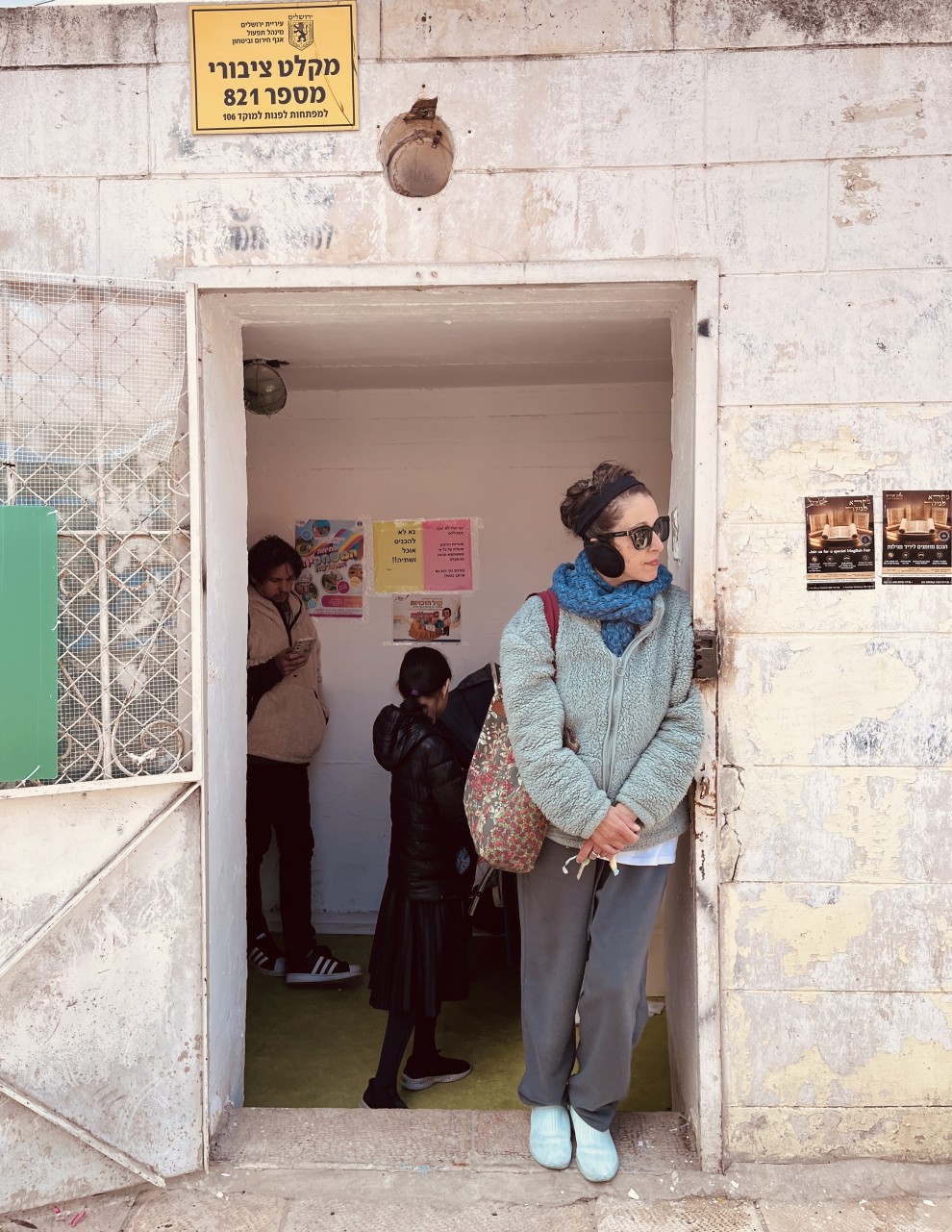
The diversity of our neighborhood’s residents is displayed in the shelter. From the toddlers who play happily the moment they hit the bottom of the steep flight of concrete stairs to the white-haired couple who arm-in-arm gingerly descend, three generations of Israelis who have endured combat on their homeland together are here.
Chassidim reluctantly snuff cigarettes before entering. A dandy draped in a fashionable scarf shows up swirling wine in a massive glass. There are dogs and cats in carriers, and one woman brings her pet parrots. “They don’t get along,” she explains, shushing them as I watch them peck each other inside a specialized clear vinyl canister.
Initially, alerts are marked by camaraderie. Pianists flaunt their skills on an aged upright piano, Cyrillic text testifying to Soviet origin. A whiskey aficionado pours single malt shots for all. “Lama lo?” (why not?) he queries, seemingly offended when I turn down booze at 5 a.m. Seeing opportunity in crisis, Israel’s tech start-up mentality inspires a dating app for the shelter visits – run for your life, scan a code and see what singles are also in panic.
Under repeated attacks I get the hang of this. Especially at overnight alerts. I become practiced at waking, dressing within a minute and navigating the streets to a shelter, and have shaved a minute of my response time adopting mission-appropriate foot gear. Wartime survival note: Hoka slides are game changers, both lace free and responsive. Crocs, I noted, are also favored by Israelis running for their lives.
*
Why did I come here knowing war was imminent, anticipating as I did that the momentousness of Purim would not be missed by Israel? One inspiration was the bleakness of this Berkshire winter. Trudging a mile through February’s slush to the Big Y only for a loaf of their joyless supermarket bread, bitter wind raking my face coming and going, was the final straw. Relentless gray frozen days got me wondering: “Why did I move to Pittsfield in the first place?” I grabbed a flight to Israel in part to evade the snow, partly to return to a yeshiva I’d studied in last May. It’s my contribution to the war effort as Torah study protects Israel in wartime, the Talmud teaches.
"As long as I am engaged in Torah, Yoav is victorious in battle,” King David – learning in Jerusalem – said of general Yoav ben Tzeruyah leading troops at the front. These two leaders enabled one another, explains the Lubavitcher Rebbe Menachem Schneerson in a sicha (lecture) of 1967 following the Six Day War.
And I went to plan a wedding in Jerusalem – my own. While I had the chance to travel on my first trip to Israel earlier in the year, visiting the artist colony of Ein Hod and the holy Safed, now there’s little to do. No gatherings are permitted, all museums are closed, and bus schedules are limited. I spend mornings at yeshiva, afternoons with my kalle (bride-to-be) Revital Ben David, and together we visit graves of tzaddikim. And as often as we pray to HKBH (Ha’Kadosh Baruch Hu), each day we run to the shelter.
Following a week of continuous attacks, the shelter party mode palpably changes. Children still play loudly but everyone else speaks quietly amongst friends, comfort pets, turn inward.
The dandy with his stemware now stares into a beer. Reservists, recently under arms and any day facing combat deployment to Syria or Lebanon, sit somber-faced until the all-clear signal sounds.
A woman in her 40s and long-time resident of the Nachlaot neighborhood, Revital abides the disruptive alerts, but the stress wears on her. We intend to marry; the war complicates things. We spend a lot of time together in the shelter. I check email from on my phone, she looks for news on the strike while tensely waiting for the alert to be lifted.
I share an upbeat announcement. Chabad of the Berkshires will be hosting a pre-Passover wine tasting and chamber music concert.
“How nice – I’m envious of Jews in the US who go to wine tastings and concerts and movies, instead of running to the miklat,” Revital says. “But Israel has a holy mission. It’s a zechut (privilege) to live here – ke’ilu b’emet (an Israeli idiom more or less equivalent to our “for sure”). This land is adamah mikudeshet be dam (land sanctified by blood). We do our avodah (work) and HKBH joins us – it is a miracle we exist. We have a job to do in Israel – it’s not going to wine tastings.”
*
I am finally forced to bail out of wartime Jerusalem – not to ‘go home” because home now can only be Israel – but to hustle together my rent money, I must get back to Pittsfield. But it wasn’t easy.
“There are no flights!” an overwhelmed US embassy staffer snaps at me after I show up at Ben Gurion Airport and security won’t let me anywhere near check-in. “You only have one bag? I can get you a flight we’ve chartered to Athens,” he tells me. I’m not buying what he’s selling. “Athens? And then what? “Get me on the rescheduled EL AL flight at 6 a.m.,” I respond. That’s on you he tells me.
Those EL AL seats went to VIPs, I learned from TV news the next day (specifically from Channel 14, “the only channel that actually likes Israel” is how a rabbi at Yeshiva Mayanot put it). I chat with a yeshiva bocher who was bouncing to Athens and then flying to Tbilisi, where he’ll overnight and then catch a plane to Zurich and then to the US. His parents, he said, will handling the tab. But that’s not me. Even If my frugal survivor-dad were around he’d only laugh good — and my cards are maxed.
For the “security situation” as Israel has titled the war, the highly efficient train back to Jerusalem ceased running overnight. I cringe, having to splurge for a cab, take a breath and see the long view. Sleep-bereft Israelis are paying more dearly – but looking toward a future when this will war will pay off.
Back to Jerusalem, my stay extended. I return to mornings of breads churned out of the Shuk’s century-old ovens. To learning, as my yeshiva continues with classes exempt from the shutdown, as its students dorm in the building. To joyously resuming shul hopping – from Shacharit at the comfortable Haredi Batei Munkatch shtiebel to Shabbos among English-speaking olim with their awesome cholent at Kollel Chaverim. Next trip, I’ll get to visit a museum and, be’ezrat Hashem (with God’s help) when peace returns to Israel, get this wedding out of the way.
A week later a WhatsApp message (Israel adores the secure phone app) alerts me to a seat on a plane to New York City take it or leave it. The United States had pressured Israel to step up recovery flights and while missiles rained down on Tel Aviv, military restrictions at Tel Aviv International limiting flight capacity are lifted.
My train to the airport is just approaching Ben Gurion station when an alert sounds. There’s no stopping. To minimize casualties, the emergency protocol while aboard demands you lay flat on the cabin floor. I enter the airport station in prone position, arms stretched forward – like Superman.
I finally make it back to the Berkshires before Pesach. I do not attend the Chabad wine tasting.
*
One night during Pesach in Jerusalem there is no alert – the warning system isn’t infallible. Awakened by the siren blaring across Jerusalem, Revital stumbled into the dark narrow streets half awake, tripped, fell hard. A stranger scoops her up and they make it to the shelter before the doors clang shut.
This isn’t sustainable, she tells me later. “Ein li koach (I don’t have the strength.) We are running on fumes.”
The son of a survivor of the Lvov Ghetto and Janowska concentration camp, Howie Stier is a longtime journalist who reported on crime and mayhem in the five boroughs for the New York Times, covered celebrity news from the red carpet and back alleys of Hollywood Boulevard for Entertainment Tonight, and has relocated to the Berkshires where he’s focused on two considerations: literature and learning Torah – as havel havalim hakol havel (breath, breath, all is breath).
IMAGE: Revital Ben David at the miklat, photo by Howie Stier.