
Among the more insidious positions held by the anti-Israel Boycott Divestment Sanctions (BDS) movement is its opposition to what it terms “normalization.” As defined on the BDS website,
Normalization is the participation in any project, initiative or activity, local or international, that brings together (on the same “platform”) Palestinians (and/or Arabs) and Israelis (individuals or institutions) and does not meet the following two conditions:
1.The Israeli side publicly recognizes the UN-affirmed inalienable rights of the Palestinian people, which are set out in the 2005 BDS Call, and
2.the joint activity constitutes a form of co-resistance against the Israeli regime of occupation, settler-colonialism and apartheid.
As Arno Rosenfeld wrote in an article on the subject published by The Forward in June, “Organizers of the boycott, divestment and sanctions movement, which seeks to isolate Israel, have focused on organizations and companies that they contend support the Israeli state, whether or not they are located in Israel, while cautioning that ‘it does not call for or condone boycotts of individuals because of their Israeli or Jewish origin.’ But that doesn’t stop it from happening.” One high-profile example that occurred in June was the attempt by anti-Israel voices to cancel actress Gwyneth Paltrow (whose father was Jewish) for filming an advertisement for a luxury property in Herzliya, Israel – an act they labeled “Gwynocide.”
But individuals, businesses, and brands that are less known and not financially insulated from cancelation are being targeted, as well. And that is something that Rachel Simons, the Australian Jewish co-founder and CEO of the New York-based Seed + Mill, believes that the Jewish and wider communities should be aware of. The boycott of Israeli products by Brooklyn's Park Slope Food Coop is merely the most publicized action of its type, Simons asserts. Many retailers and consumers in the US and overseas – and some in the Berkshires and Hudson Valley – have stopped purchasing Israeli products and ingredients even if they are made (as her company’s offerings are) collaboratively by Jews and Israeli Arabs.
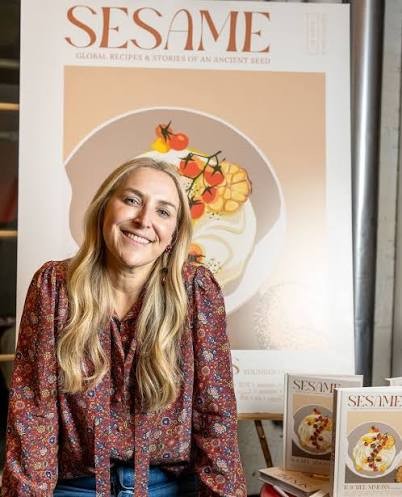
Simons – who presented a program for Federation last February about her cookbook Sesame: Global Recipes & Stories of an Ancient Seed – spoke the BJV about how these organized and personal boycotts have affected her craft tahini and halava business. Our conversation was edited for length and clarity.
The BJV Interview: Rachel Simons of Seed + Mill
BDS is affecting businesspeople like yourself who are trying to work cross-culturally. How have you been affected?
Our business is 10 years old, started in New York City in Chelsea Market. Our values as a business have always been inclusivity, using food as a vehicle to connect people of all different faiths and cultures. Those are my business values and my personal values. We've sourced our tahini, which is our core product, from Israel since we started. The production and the industry over there are really vibrant and strong. They make excellent products, and we wanted a premium ingredient.
I could have sourced my tahini here in the US, but I wanted the best of the best. There was no ideological reason per se for me to have sourced my ingredients and products there. We are a brand that outsources our production, which means we co-pack our products. We've worked with the same co-packer for many, many years, and have a fantastic relationship with them. They happen to be Muslim Israeli Arabs. Their factory is very multicultural. They employ people of all faiths and colors, and it's a big factory that exports all around the world. They and Seed + Mill are being punished by a campaign that purports to want to provide liberation and freedom and dignity for people in Israel. My personal view is that this campaign is not doing anything of the sort, and it's punishing the people that they purport to want to help.
I don't think it would be morally fair or appropriate to boycott Jews or Arab Israelis. So whilst they happen to be punishing Arab Israelis in this case, I don't think BDS is a morally appropriate campaign regardless of the target.
The Park Slope Food Coop got a lot of press because of where it’s located and the type of people who shop there. How did their boycott specifically affect you?
The Coop voted to take our products out of the store, so we will lose that revenue. It obviously also impacts team morale. But it's not the first time that our business has been boycotted. We've had other buyers at specialty stores tell us that they will no longer carry our products because they're manufactured in Israel. We also have consumers who used to purchase from us who reach out and tell us, “Oh, I bought your product from your store or on your website, and now I see on the label ‘produced in Israel’ and I want a refund.” Some want to share their views on how they feel about where we manufacture. There have been multiple ways we have received opinions and negativity or boycotting of our products in the last four years.
Do you feel like it's a grassroots kind of thing where people are responding to their own political views, or do you feel that it's more organized? For example, will a buyer get a list of companies like yours that uses manufacturers in Israel?
I think it's both. I think there's been a lot of individuals who are not part of an organized network who have a view and they are reaching out independently and individually. And then I think there is obviously a very organized campaign that is trying to make this have a wider impact. So, it's coming to us both ways.
You say you said that when people reach out to you, they use it as an opportunity to express their political views. Do you feel harangued if they tell you to stop working in Israel? What do they want from you?
I'm glad you asked that question because actually I don't feel harangued. If anything, when somebody reaches out to tell me about their purchasing decisions, at the very least it gives me a moment to engage with them and to humanize my business and to humanize the people who are making our products over in Israel. I'm at least grateful when somebody will tell me what they're doing and why, because that is the first step in a dialogue. I engage with every single person, and I try to explain to them why I don't think their actions are productive or moral.
I'm not an activist [but] I have an opinion. I want stability and peace and dignity for people in Israel of all religions. I'm not an extremist. I'm a human, and I try to just explain why this BDS campaign is just not going to help. If you genuinely believe that both Jews and Palestinians deserve to live safely and peacefully, then I try to explain that this isn't the way to get there. All I ask is that we actually have a genuine conversation. I don't like to be screamed at with slogans, and I do get…I get a lot of slogans, people who just yell at me and say, 'You're complicit in genocide.' That’s not productive.
I'm probably most upset with what happened at the Park Slope Coop because I've been supplying products to them for 7 years. [Seed + Mill] is a New York business. I live in New York. My team members work in New York and, in fact, some are members of the Coop. I would have been a Coop member had I lived nearby, because I like co-ops. I'm sort of one of them – I appreciate the model that they're building. Had had someone at the Coop said, “Hey, would you like to come and talk to us about this issue,” I would have liked the opportunity to do so. It’s this way that I feel like the BDS campaign, from my experience directly, doesn't seem to be a genuine effort at peacebuilding. Because if it was a genuine effort at peacebuilding, they would have at the very least said, “Would you like to come and talk to us?”
How have your Israeli Arab suppliers and partners responded when you explain what’s been going on in the United States?
They're devastated because ultimately this is going to deprive them of a job and an income. And the trajectory and the history of the BDS has been to take jobs away from ordinary Palestinians. The other irony is that, you know, these are food producers. We're not talking about people in tech or banking and finance. BDS somehow always seems to want to target the people making tahini, of all things. So [my Israeli Arab partners are] confused. They feel unseen. They feel that they're the collateral damage in a much bigger conflict.
You know, you've probably heard the expression that in academia, the battles are so vicious because the stakes are so small. It’s kind of the same thing here. Maybe people can't relate to banking or finance or arms manufacturing, but they can relate to a can of tahini and allow that to become the vehicle for their disdain and their anger.
We're a teeny tiny tahini company. Really – that’s the target of your anger? You’re contacting me from a part of the country where we've actually had a lot of hate. Some of our stores are in the Hudson Valley/Berkshires area, with the sort of small specialty stores where we have had quite a lot of loss of relationships and loss of accounts. The Hudson Valley has, more so, been a pretty difficult place. I live nearby, and my team is also connected to this region. Half of my team in New York, by the way, fast on Ramadan because they're Muslim New Yorkers. These are all people who deserve to live and have jobs and talk to each other with some common sense and some pragmatism. BDS just feels like a campaign of pure racism with zero pragmatism or genuinely-held authentic desire for peace.
Seed + Mill products are available at www.seedandmill.com.