
By Carol Goodman Kaufman / Special to the BJV
Hanukkah is just around the corner, and that means it’s time to start thinking about the holiday menu. Of course, there are always the traditional foods fried in oil (you know, the latkes, sufganiyot, and bimuelos, among others), but what about something that doesn’t need to be fried? Something that still incorporates the key symbol of Hanukkah?
My firstborn, Seth, has always been interested in cooking. One of my earliest memories of him in the kitchen is of his baking a carrot cake. But instead of canola or coconut oil, my usual go-tos for pareve baking, he had chosen olive oil. I recall being worried that the resulting cake would taste awful.
Well, I certainly learned my lesson. The resulting cake was delicious. In the ensuing years, I have found other uses for olive oil in sweets, none of which require frying in deep fat.
But let’s talk about the olive oil itself. We all know the story of the Hanukkah miracle, repeated every year in Hebrew school. A little cruse of pure olive oil (did you even know what a cruse was when you were eight years old?) lit the Temple’s menorah a miraculous eight days, the same length of time it took to get a fresh supply.
But why olive oil in particular?
Given that the Mediterranean has the right conditions to encourage growth and health — perfect climate, two clear seasons, and water—it was natural for our ancestors to cultivate olives for oil. Olive products were a major part of the early economy in the Land of Israel, and the oil has been indispensable throughout history for lighting and cooking, as a curative, and as a nutritional supplement.
Olive trees are among the oldest known cultivated trees in the world, having sprung up in their wild form 20 million years ago, as fossilized remains attest. They can live for millennia. In fact, the trees on Jerusalem's Mount of Olives are reputed to be over 2,000 years old.
And since we’re talking about Hanukkah, the olives from which the oil was produced for the rededication of the Temple reputedly came from Tekoa, in the Judaean hills just a few miles south of Jerusalem. Those trees may actually be alive today.
Olive oil could even be used as a form of currency in trade. In the Second Book of Kings (Chapter 4, Verses 1-7), the prophet Ovadiah's widow goes to the prophet Elisha to inform him that her sons will be taken due to her inability to pay her debts, and to ask him for advice. When asked what she has in the house, the woman tells Elisha that all she has is a vessel of olive oil. He then instructs the woman to borrow as many vessels as she can from her neighbors, to fill every one with the oil from her house, and then to sell the oil. The oil keeps flowing until all the vessels are filled, allowing her to save her sons from slavery and to make a living. Another miracle involving olive oil, perhaps?
Olive oil was also essential for sacred purposes. It was used for anointing kings and high priests, as we see in several sources. In the Torah itself we read, “And he [Moses] poured some of the anointing oil on Aaron’s head, and anointed him, to consecrate him.” (Leviticus 8:12) In the Prophets we read that "Samuel took the horn of oil, and anointed him in the midst of his brothers; and the spirit of the Lord came mightily upon David from that day forward.” (Samuel I, 16:13) Also in Prophets: “There Zadok the priest took the horn of oil from the tent, and anointed Solomon. Then they blew the trumpet; and all the people said, “Long live King Solomon!” (1 Kings 1:39)
Olive oil was the fuel for the golden lamps in both the Tabernacle in the desert and the Temple in Jerusalem, and it was part of various offerings, either by itself (Exodus 29:38-40) or mixed with flour into cakes (Leviticus 7:11-12).
Surprisingly, people didn’t actually use the fruit of the olive tree as a food until the Second Temple period. (Their mezze platters were obviously lacking.)
On the negative side, the use of olive oil for cooking could get Jews into trouble with the agents of the Holy Office of the Inquisition. Because they wouldn’t use pork fat for frying as their Christian neighbors did, Jews used olive oil instead. The aroma of meat frying in olive oil apparently is different enough from that of lard that neighbors would report them to the Church, bringing untold grief. Holy indeed.
Back to Hanukkah: Most of us tend to use colorful wax candles for lighting in our hanukkiot, either those in ubiquitous little blue cardboard boxes found on supermarket shelves, or fancy schmancy ones from Israel. Cheerfully colorful, their dancing flames provide a bright and cheerful addition to the holiday.
While candles are perfectly acceptable, oil is the more historically accurate choice due to its prominent place in the story of the miracle. And it’s not all that difficult to do. All you need is an oil hanukkiah, extra virgin olive oil, and a cotton wick. As with candles, place the oil cups from right to left, and light them with the shammash from left to right.
FYI, we do not light a menorah for Hanukkah. A menorah, like that in the ancient Temple, has seven branches. A hanukkiah has nine: one for the shammash and eight for the days of the holiday.
And speaking of the menorah, in case you’ve forgotten that part of the story: Rome, under the Emperor Titus, sacked the Second Temple in Jerusalem and took 50,000 Jews back to Rome as slaves. Among the spoils of war was the Temple’s menorah. Titus had a triumphal arch built to celebrate his victory, and on that arch is an engraving of that very menorah. You can still see it on the arch today. That menorah is also the symbol of the modern State of Israel.
(FYI: Some scholars have determined that many Ashkenazi Jews have Italian DNA from having intermarried with locals back then.)
So, proclaim the miracle and light up the night. Happy Hanukkah!
To see how olive oil was made in ancient Israel, visit tinyurl.com/IsrOliveOil and view a real oil press from Katzrin in the Golan Heights.
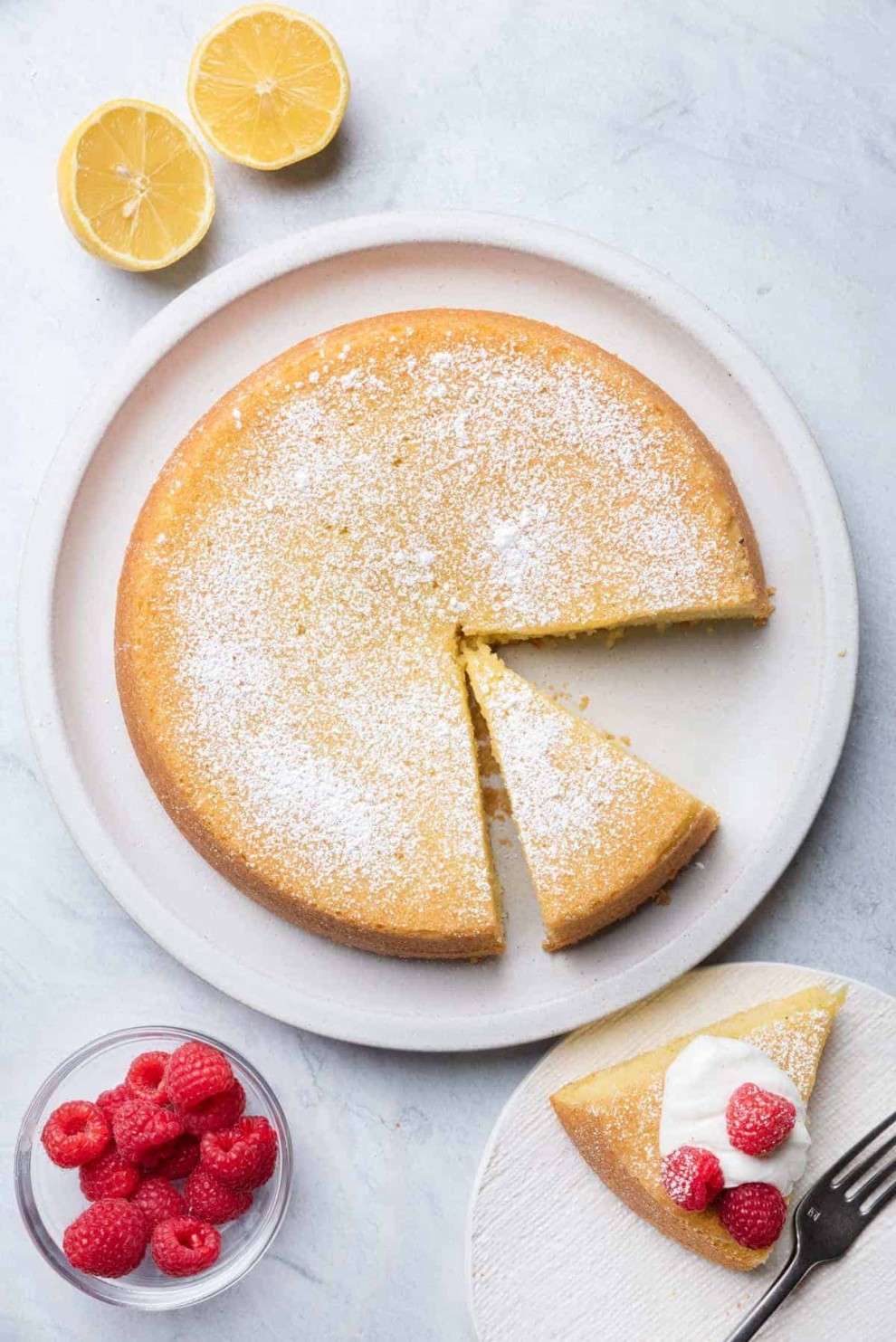
Olive Oil Cake
Between the olive oil and the citrus in this recipe, dreams of golden Mediterranean afternoons will fill your mind when you bite into this moist confection.
Ingredients:
1 cup fresh extra-virgin olive oil
2 cups all-purpose flour, plus more for the pan
1 teaspoon kosher salt
1 teaspoon baking powder
¼ teaspoon baking soda
1½ cups granulated sugar
3 large eggs, at room temperature
Grated zest of one lemon
Grated zest of one orange
Juice of one lemon
1¼ cups whole milk, at room temperature
Confectioners’ sugar and raspberries for garnish
Directions:
Set the oven to 375 degrees.
Coat a 9-inch round cake pan with baking spray and line the bottom with parchment paper. Then spray the parchment and flour the pan, shaking out any excess flour.
In a large bowl, whisk together the flour, salt, baking powder and baking soda.
In the bowl of an electric mixer set on high, beat the sugar, eggs and lemon zest until very thick and fluffy, about 5 minutes.
With the mixer still running, gradually add the oil and beat until incorporated, another 2 minutes.
Reduce speed to low.
Add the milk and lemon juice.
Gradually add the flour mixture and beat until just combined.
Transfer the batter to the pan.
Bake the cake until a toothpick or skewer inserted into the center comes out clean, 40 to 45 minutes.
Transfer to a rack to cool for 20 minutes, then run a knife around the edge to release the sides of the cake from the pan.
Invert the cake onto a plate and then flip it back over onto the rack to cool completely.
Dust with confectioners’ sugar and garnish with berries.
This cake will keep for a week if well covered.
Carol Goodman Kaufman, has just published her second mystery book, Crak, Bam, Dead: Mah Jong Mayhem (Next Chapter Press). The collection of cozy mystery short stories features food writer/aspiring investigative reporter Kiki Coben and her Mah Jong group as they follow clues from a “Black Widow” murder at sea to a suspicious death at a senior home charity event. Armed with a curious mind and her formidable group of friends, Kiki is ready to prove that the only thing you need to catch a killer is persistence – and maybe just a little bit of luck. Crak, Bam, Dead is is available in stores and online.