
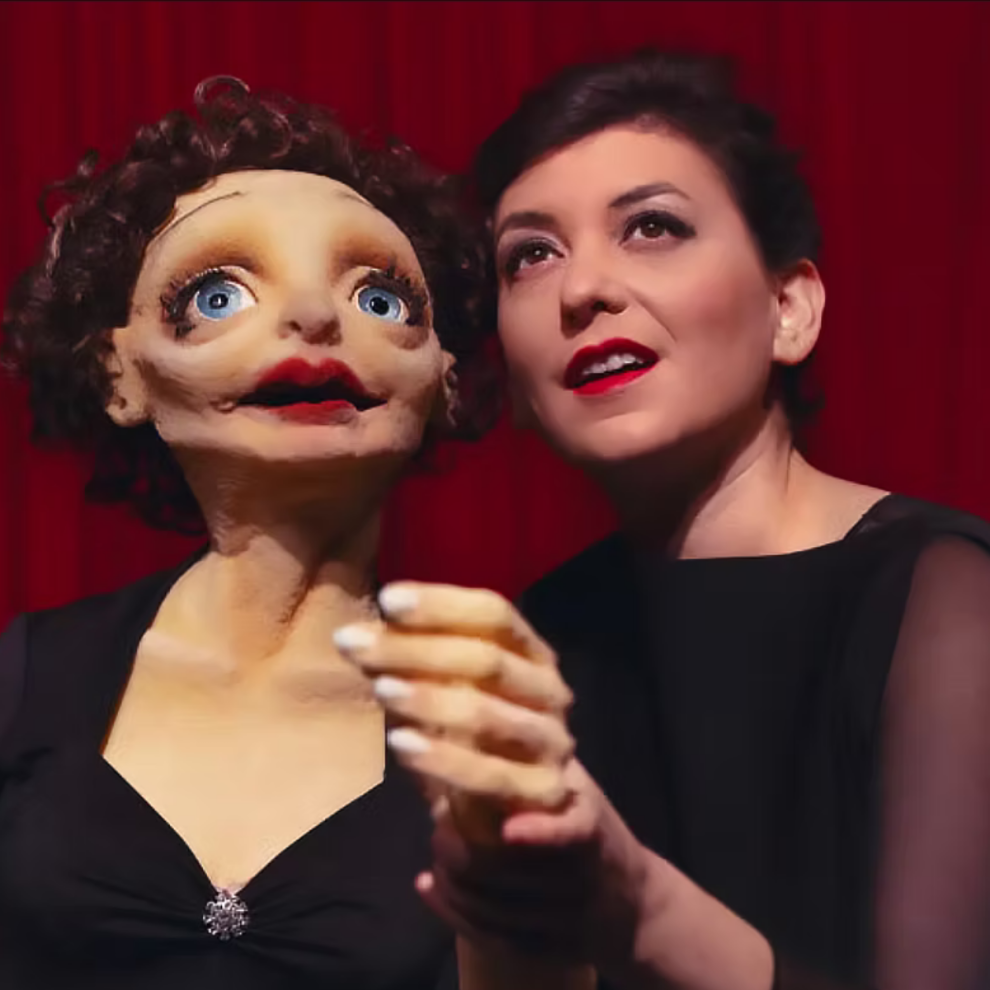
Singer, actress, and puppeteer Yael Rasooly’s evokes the Paris and Berlin of a century ago
By Albert Stern / BJV Editor
“The power of cabaret,” says Yael Rasooly, “is what, with minimalistic means, what you can get away with saying. It is made for times when people are on the move, or have to do with very little, and is always that magnificent dance of entertainment shining a light on things we don’t want to look at, or giving people courage in a certain way, making them feel seen and that their emotions are valid.”
Rasooly, who has staged her work around the world, will be bringing her music, storytelling, and puppetry to the Mahaiwe Theater in Great Barrington on December 13, when Close Encounters With Music (CEWM) presents "Come to the Cabaret! Paris and Weimar Berlin." The Jerusalem native will be joined onstage by longtime collaborator, Israeli pianist Daniel Rein, and trumpeter Rafael Castillo-Halvorssen.
CEWM is known for its eclectic and illuminating programs – some take deep dives into an aspect of a musical artist’s work, while others juxtapose works of several composers and sometimes different art forms to explore connections and influences. High art compositions performed at symphony halls and recital stages might seem a world away from the outrageous music hall numbers of the 1920s and early 1930s that were conceived for louche dives like the Kit Kat Club immortalized in Kander and Ebb’s Cabaret. But, as CEWM’s artistic director Yehuda Hanani points out, the European high culture and subcultures of the interwar years emerged from the same ferment of ideas and anxieties that preoccupied all manner of creative types following World War I.
In the 15-year period from the end of the war until the rise of the Nazis to power in 1933, Hanani explains, Berlin was “a goulash of cultures” in which writers, visual artists, composers, architects, filmmakers, and philosophers were trying to process the war’s devastation and find a way forward. The city brought together refugees from the Bolsheviks, communists trying to replicate the Russian revolution in the West, monarchists dreaming of restoring Germany to greatness, modernists trying to remake modes of expression and representation, and bohemian outsiders of every stripe looking for excitement. The economic situation was dire and the atmosphere during this ‘Age of Anxiety’ felt dangerous and often hopeless. Boundaries between the elite and the demimonde were fluid. “Strangers in converged in Berlin for this brief period, which was aesthetically unique,” says Hanani. “High culture was trying to make sense of things. Cabaret is the underbelly of that same culture of angst, cynicism, sarcasm, and doom. All of it was part of the same picture, all in dialogue with one another.”
The songs from Germany tended toward the provocative and satirical, while the songs from France largely emerged from the poetic chanson tradition. Yael Rasooly will be performing in both styles, using likenesses of both Edith Piaf and Marlene Dietrich that she helped design and that were crafted by Israeli-born puppeteer Revital Arieli. Rasooly has been working with the Piaf character for the last four years, first in her cabaret act and then in the full-length show Edith and Me that emerged from her own dark places. “It’s my personal story of how Edith Piaf saved my life, a story of overcoming violence and darkness and silencing and finding your voice again and healing and reclaiming your life and your love,” she says. Her Marlene puppet is a newer character for Rasooly, who is developing a show around her. Rasooly will ventriloquize both divas.
The songs from both singers’ repertoires were chosen for their “exquisite lines for an emotional journey. Edith Piaf, especially, could sculpt a narrative and a story in her songs the main characters of which were mostly about people on the outskirts of society that she's giving a voice to. And there is always a power and a force in them. And then, there's the Marlene Dietrich songs, which are much more frosty and detached and gigantesque. I flourish where these things meet.”
Modern cabaret, she adds, is “still about people taking risks and showing something very surprising and individual and independent. It's normally short numbers and short formats, and I am a great believer in things being concise and saying things in the short time that you have. [Cabaret] runs deep and is about subversive culture and resistance and resilience. In these dark days that we're in, these meeting points are what they always used to be. They still come with all the light and all the shine and all the heartbreak and all the daring.”
Originally trained as a classical singer and pianist, Rasooly felt stifled in that world and gravitated to performance art. To interest investors in the full-scale productions she had in mind, she started to create miniatures to convey as sense of what she wanted to appear onstage or in a film. At a certain point, Rasooly began to consider that maybe these objects she was creating in her living room were actually going to be the show she was going to be able to stage – and that she was going to be the one to act out all the characters she could not afford other actors to portray. That developed into a one-woman show Paper Cut, with which she toured in 35 countries for more than 17 years and that you can watch parts of on YouTube (along with other charming cabaret performances filmed around the world).
“But the music and the sound universe is always the base for me,” says Rasooly. She will be backed by versatile accompanist Daniel Rein, who was trained at the Jerusalem Academy of Music and the Royal Academy of Music in London, and who work in both the classical and jazz idioms and who served two years as music director for the European tour of Cats and as an associate conductor on productions of Les Misérables and the Radio City Christmas Spectacular. Together, they’ve performed in clubs and at sold-out performances at the Neue Galerie in New York City (where they'll be on January 14, 2027) since 2019.
“My big inspiration when I started was early jazz and swing,” says Rasooly. “The Neue Galerie asked me to make a program of Weimar era songs, most Brecht and Weil, and sometimes I have evenings of only this repertoire, or only the chansons, or only the English-language song. But me being who I am, why not to have it all, to be honest? Because everything is so connected in this era, reflecting different cultures and countries. And then, you know, the best actor in the world is a great puppet. And I do have some great puppets in my hands – they have their own personality by this time. In the Berkshires, we are going to be moving between all the worlds I love.”
Close Encounters With Music presents “Come to the Cabaret! Paris and Weimar Berlin,” on Sunday, December 13 at 4 p.m. at the Mahaiwe Performing Arts Center, 14 Castle Street in Great Barrington. For tickets, visit cewm.org.