
By Rabbi Val Lieber / Temple Anshe Amunim
Rosh Hashanah, Yom Kippur, and Sukkot are behind us and we are in the Hebrew month of Cheshvan. We enter this month with a fresh perspective. Some people say there are no holidays in Cheshvan. But that is not the case. There is a Jewish holiday none (or nearly none) of us grew up with which falls every year on the 29th of Cheshvan – November 9th this year: Sigd.
November 9th is the date we memorialize the horrors of Kristallnacht every year since 1938. This year, by coincidence, it is also the date of the Ethiopian Jewish holiday Sigd.
It is an ancient holiday, but I only became familiar with it in 2008 when Israel made it a national holiday. Since that time, it has become more widely observed around the world by non-Ethiopian Jews.
I was in high school when the news came out in January of 1985 that thousands of Ethiopian Jews had been spirited away to Israel by planes from Sudan in a top secret operation. It was called Operation Moses. The incredible heroic rescue of Beta Israel like nothing in Jewish history save the rescue of Jews from Egypt in the book of Exodus. From my teenage perspective, Operation Moses was sandwiched in time between the release of “Do They Know It’s Christmas (Feed the World)" by the British rockers in BandAid, and “We Are The World” by American pop artists, USA For Africa. Both of those songs called attention to the calamitous hunger ravaging Ethiopia, and raised millions of dollars to help those who gravely suffered. Even before those famous MTV videos, I was aware of the famine in East Africa. However, I was not familiar with the millennia-long Jewish community of Ethiopia. Like many other American Jews of that time, I was captivated by the story of the Ethiopian Jews in the Gondar Province.
When I first visited Israel in 1987 during college, I was dazzled by the diversity of Jews. The mix of people stood out to me, particularly when riding the buses. I was absolutely thrilled to see Ethiopians on the bus – here they were, in person! The range of Jewish ethnicity in Israel was not something I grew up with in Indianapolis, Indiana, where the Jewish families were mostly named Hirsch, Kleinman, Fineberg, and Kuperstein – Ashkenazi Jews as far as the eye could see. Being in Israel and bearing witness to the diverse lives of Jewish people made me feel even prouder to be Jewish than I already was. What a breathtaking group we are! We lived in so many places, shared a variety of backgrounds, cultures, foods, languages, and ways of life that I was only just beginning to understand. Jews from Ethiopia, India, Tunisia, Turkey, Kazakhstan and so many other places have brought incredible cultural riches to the world, primarily to Israel.
Israel has made it a cornerstone value to provide a safe haven for Jews the world over. The rescue of almost 50,000 Yemeni Jews in Operation Magic Carpet in 1949, and the rescue of over 20,000 Ethiopian Jews during Operation Moses, and again in Operation Solomon in 1991, are enough to make me a proud Zionist. To me, this is the definition of the word ‘Zionism.’ While I am critical of Israel on many of its policies, I am so deeply proud that Israel has given a home and citizenship to so many “tempest-tost” Jews. For every Jew whose ancestors lived in the shtetl, there is a Jew whose family lived in the Moroccan Casbah or Syrian Aleppo or along the Tigris River in Baghdad. As a rabbi I’m inspired to educate all who are interested about the wide range of diverse Jewish cultures.
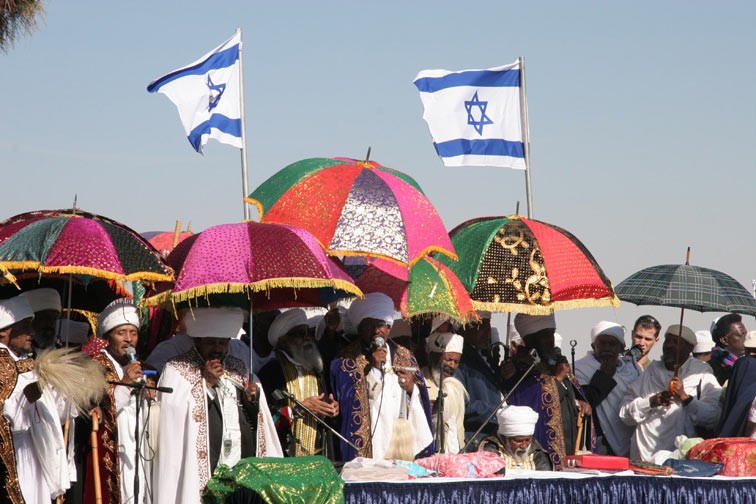
Regarding Sigd, I’m still just a beginner in observance – mostly I listen to Ethiopian Jewish music and cook and eat Ethiopian food. Last year at Temple Anshe Amunim, we cooked one of my favorites: red lentil stew – Misir Wot – and people loved it. The Ethiopian community observes much more fully. The holiday always falls 50 days after Yom Kippur so it offers a second chance to repent and find the inspirational power of the Day of Atonement. In the Semitic language Ge’ez, sigd means “prostration” - deep, humble bowing – a custom which is part of the observance. Other hallmarks of the holiday include ascending a mountain (like Jerusalem), wearing white, carrying colorful umbrellas, and fasting until mid-afternoon when a feast and music conclude the holiday.
If you are interested to know more about Ethiopian Jewish culture or those of other Jewish groups which are not widely represented in America, I encourage you to check out GlobalJews.org. It is a fantastic resource for life beyond Ashkenazi culture here in the United States and abroad. Next summer, I’m planning to teach a multi-session class about Jews Around the World. So keep your eyes peeled.
Rabbi Val Lieber is the spiritual leader of Temple Anshe Amunim in Pittsfield.