
By Albert Stern / BJV Editor
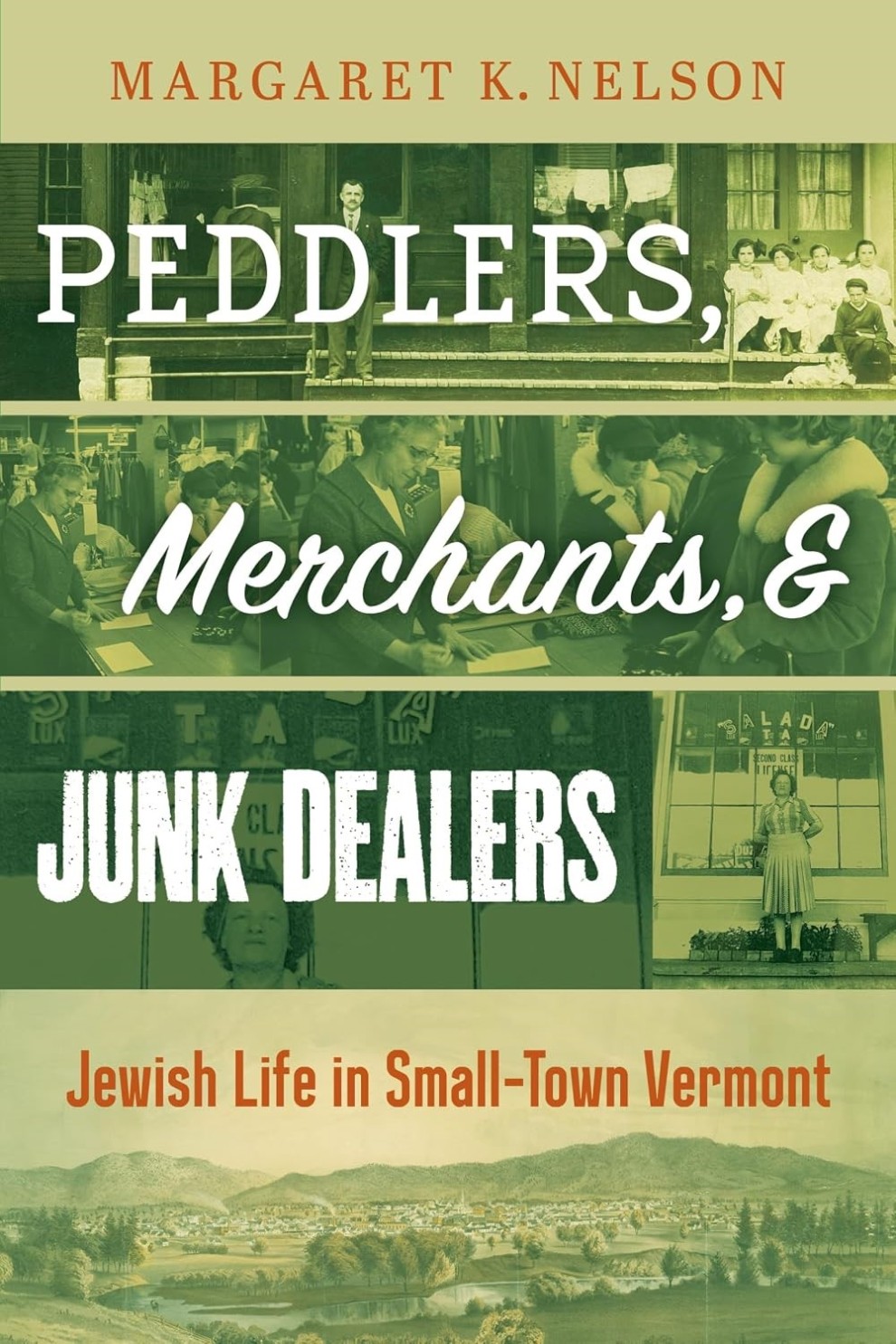
On Thursday, October 22 at 7 p.m., Federation hosts Professor Margaret K. Nelson, Professor of Sociology Emerita at Middlebury College, who will discuss her book, Peddlers, Merchants, and Junk Dealers: Jewish Life in Small-Town Vermont. This Federation program will be presented via Zoom – register at the calendar of events page at jewishberkshires.org.
For many years, histories of Jews in the United States focused on Jewish migrants who settled in large cities. Peddlers, Merchants, and Junk Dealers offers a rare study of Jews in small town America, illuminating the experiences of Jewish families in towns where they constituted one of, at most, a few Jewish families. In particular, the volume explores the occupational niches of Jews in rural Vermont, from peddling to the ownership of junk yards and dry goods stores that were disparagingly known as “the Jew Store.”
The book also looks specifically at the experiences of Jewish women and children in families headed by men in these occupations. These families lived in communities where they were often isolated from relatives and friends, and without a Jewish congregation. Professor Nelson carefully investigates various aspects of this small-town experience, including how generations of immigrants were regarded by others, how they held onto the practice of their religion, and how they were able to socially integrate into their communities.
By narrating the trajectory of Jewish immigrant experiences through men’s occupations, the volume places the experiences of Jews in Vermont alongside those of other marginalized groups, particularly the families of Chinese restaurant owners and South Asian motel managers, as they established and sustained their own distinctive economic activities in small towns.
In September, Professor Nelson spoke with the BJV about her research. Our interview was edited for length and clarity.
The BJV Interview: Margaret K. Nelson
You describe Vermont as a very rugged, mountainous place with harsh winters, a mud season, and hot summers. Did these Jewish immigrants, when they arrived, know what they were getting into in terms of the physical landscape that they would be living in?
it's a great question, but I really don't have an answer for it because I don't know what they were imagining when they came here. I know that most of the people who came were very, very grateful to be away from the pogroms in Eastern Europe. For instance, in Burlington there's a story about a woman kissing the street and saying, ‘I'm so grateful to be here.’ Some of the oral history interviews that other people collected also talk about how grateful people like Max Fishman, who's kind of a star in my book, was to be here. Max Fishman [settled in Vergennes and] brought over his sister, Zelda, and brother-in-law, Aaron Cohen, who then becomes the junk dealer in town. Then he brought over his brother Meyer, who actually ended up becoming a multimillionaire [owner of a department store chain].
He also brought over another brother-in-law who came to this country, but who left his wife and children back in the area of Belarus, Poland, Russia. That sister was murdered in a pogrom along with several of her children. So, in terms of expectations, I think they came expecting to be safer. Most people, of course, went to cities, and I think that for somebody like Max Fishman and then Abe Cohen, the idea of being in a small town felt safer to them. Burlington, which is 30 miles up the road from Vergennes, had a substantial Jewish community, as did Rutland, which is 50 miles in the other direction. Both of them had synagogues, and more than one Jewish family in the community. I'm not sure exactly why these people didn't want to be in neighborhoods with a lot of other Jews. I have some hypotheses about it, but I think that they really felt that these small towns offered an economic niche for them and also offered them some kind of safety.
You've seen in the book that I laid out a couple of routes [they took as peddlers]. Those routes take you across mountains that are 3,000 feet high. They take you down into valleys. I was traveling recently between Rutland and a place 20 miles north called Florence. Maybe you see just one house, and then you go another couple of miles, and there's another house, and you go another couple of miles. They might be going to a small town where there might be a cluster of homes, and then the landscape would spread out, and there were probably long periods where there was nobody. There is still nobody on the tops of these mountains. And then they’d come to another house. Now, winters are always brutal in Vermont and they probably were more brutal over 100 years ago when it got a lot colder. When I came to Vermont in 1975, we always had a week in the winter of when the temperature dropped to 20 below and didn't go above zero for a week. That rarely happens now, but it certainly did then. And there must have been more snow and more ice and more everything. Maybe the summers were easier than they are now.
You interviewed, Ed Hirsch [a third-generation Vermonter who was educated at Dartmouth and Cornell, but moved back to his hometown of Lebanon in the 1980s to take over the family department store], who said, “it took a different person to move up to Vermont.” And he added, “at least anyone who accepts themselves as a Jew.” How do you interpret that? What was he trying to convey?
I think he was saying this isn't an easy place to be Jewish. His family was in Lebanon. His father had spent some of his life in Brandon, living with his sister. Both were not places where there were many other Jews. For him, it was how do you maintain your identity as somebody who is Jewish when, on a daily basis, you're surrounded by Christians? How do you find community among other Jews while not also alienating the people who are your clients, none of whom are Jewish? I don't know that Ed Hirsch himself had wanted to take on that challenge. His father certainly wanted to take on that challenge. Ed's father had graduated from Rutgers University, and had been headed towards a professional career but got waylaid by having been [in the military during World War II and] involved in interviewing people for the Nuremberg trials. He came back to Vermont and said, I need to be safe, I need to be secure – but did not choose to live among Jews. I think they never gave up their sense of themselves as people who were connected to other Jewish people, and yet they chose to live among Christians. That's an interesting and brave and creative choice, and also a choice that was challenging every day in every way.
About the career choices that they had – you write how the more sociable people became peddlers and store owners, while perhaps the more analytical kind of personalities tended to go into the scrap metal and junk business. When these immigrants came over, what kind of pipeline did they have to recognize the businesses in which they could succeed as Jews in America?
If you ended up in Burlington as a Jew, maybe it was because your relatives had already gone there. Some people were sent there because of the clean air and to get them away from industrialized places. If you landed in Vermont, you could buy a pack or rent a pack from supply stores and everybody said, put a pack on your back and go out. That was really the only possibility for starting out and it wasn't terribly expensive. You'd come back to the supply store at the end of the week and you'd say, I sold this and I sold this, so give me more needles, give me more thread, give me more whatever. And you would start out again the next week. They were creating a consumer base.
They found out that they were good at. They found out if they were good at talking up people. They found out people liked to have them come sit on their porch and spread the news. I think the more sociable people did enjoy it. Max Fishman, whether he liked peddling or not, clearly loved being at the center of a store and being sociable in that way. [His brother-in-law and junkyard owner] Abe Cohen came with some experience as a fur trader and so part of what he did in this country was trade furs. Now, if he had wanted to be have a dry goods store, he couldn't have done it in Vergennes because Max already had one. So sometimes the options were, do I want to stay where I know one other family or do I want to move on? But these were pretty much the only possibilities.
I was once asked what these men did before they came. Most of these men had no occupation before they came. Maybe it was a brother who brought them over at age 16 and said, okay, see how you can manage peddling. It's not as if they were going into a career path that they were choosing. There were very few options.
You write about the differentiation between residents and strangers, terminology borrowed from sociologist Peter Rose. Explain that so people have an understanding as they come into your talk.
Peter Rose was saying that these very minority Jews living in small towns had a utilitarian approach to the town – this is where I live, but I'm not really of the town. I will make my living here, I will talk to the people here, I will abide by the local norms, but I'm not really a member of the community. Both people’s perception of them and their perception of the people in the community was one of difference, of strangeness. Now, that's too simple a way to describe anybody. When they lived in these communities, maybe they didn't go to other people's houses for dinner. They kept kosher. But they knew people and their kids were going to school with one another. And they became aldermen and such, and they became integral to the community. It's not just, oh, these are people buying from my store, but these are my neighbors.
In that sense, I think even in the early years, even in a Max Fishman before he left his store over to his daughter and son-in-law in the 1930s, wasn't just a stranger. I think he was a resident, but he also was a stranger. That is, people saw him as being different, and he saw himself as being different. So much community activity takes place in the church, and of course he didn't go to the church. I got a letter from a [non-Jewish] friend of mine who grew up with some of Max’s grandchildren, and she wrote that his family had so much respect in the community, but they knew the Fishmans were Jewish. She said she didn't necessarily know whether somebody was Episcopalian or Catholic or Baptist – they just were part of the community. But she knew this family were Jewish people and were different even though they were well-integrated and had friends in the community.
Explain the “exemption exception.”
So, say, if you asked somebody in Vergennes, what do you think about Jewish people, they might answer, “Oh, I don't like Jews, but Max Fishman, he runs a good store. Sarah Gould, she's generous, she's kind. I like Sarah, but I'm not sure I like Jews.”
You point out how that in the beginning the difference was perceived as ethnicity or religion, but in subsequent generations, there started to be class differences as these merchants prospered and some even did fantastically well. How much was baked into the next generations to try and stay a little bit under the radar, not so much because of their Judaism, but because of the class distinctions?
Ed Hirsch is somebody who's very clear about that. He says, “In Lebanon. I live the way people in Lebanon live. I'm not showy. I don't go off to Florida. It was important to people.” Some of the people in the Max Fishman family and subsequent generations called me and said my discussion of class made them a little uneasy, because they had tried very hard not to distinguish themselves by being quite wealthy and some of these people did become quite wealthy. But I also think that in spite of the notion about small towns as petty places where people gossip and whatever, some of them were genuinely democratic. Everybody lived next to each other. People respected each other across class lines.
You write a great deal about the lives of women and children, and how through the children, these families truly became integrated into the community. But you also describe how a lot of women felt the absence of Jewish community more profoundly than men and more directly, as they were in charge of the home and keeping kosher, and perhaps in the education of the children, as well.
Max Fishman had 3 wives. One of them died, the other 2 left. About the women in the first generation – and one of them is Abe Cohn's wife, Zelda – they were trying to keep kosher, which meant that their meat came from far away. They were seen as being peculiar, and probably as being antisocial. I think that their lives were very difficult. A lot of these women came from urban areas with other Jews, and there they were in the middle of nowhere with very few people around. I think it became easier with each generation, especially if people had children who were integrated into the community, who had friends in the community. I think when families stopped really trying to keep kosher. being a housewife became easier.
When women became more involved in the businesses, then their lives became social the way their husbands' lives were social. Some of these women were much better at being sociably involved in the stores than the men had been. It was extremely hard for the first generation of women, then easier in subsequent generations who grew up in the United States, didn't speak with an accent, didn't dress differently. [In the book, Professor Nelson describes the tragic story of a woman who could not adjust to rural life, attempted suicide and was ultimately institutionalized.] Less tragic are the women who just said to their husbands, “I'm not staying in Vergennes. I'm going to live in Burlington, and you can commute and I'll raise the children there where they can have a Jewish education.” There was a pattern of women just getting up and leaving.
Towards the end of the book, you describe what differentiated a lot of the Jewish settlers in Vermont from more recent immigrants to America. You point to South Asian motel operators and Chinese restaurant owners and show how those families tend to stay in these small towns and expand their interests, whereas after the second and third generations, it seems more likely that a young Jewish person would leave the small towns. That's true, I guess, in the Berkshires, as well. How has Vermont changed for Jews since the days of these still pioneering merchants?
I think we live altogether in a more tolerant society than 100 years ago, although I'm not holding to that these days. We all know that there's a lot of resurgent antisemitism. If you'd asked me this question maybe ten years ago, five years ago, I might have answered a little bit differently. For people who care about a Jewish identity and care about a religious experience for their children, it's more possible to find that in small towns. People I interviewed for the conclusion of my book were people who came as professionals, and I think they're more Jewish than they would be had they stayed on the Upper West Side in New York, because it still feels like being in the wilderness. Places like the Middlebury Havurah, which was created by colleagues of mine and friends of mine, exist because people came and said, ‘How do I continue to show that I'm Jewish in the wilderness?’ A lot of those people, had they not been in a place that's so white and so Christian, and in many ways so cold, they might not have created this kind of organization. They might not even have given their children religious education. I think it becomes more important to some people to develop and maintain a Jewish identity when they are such a distinct minority.