
By Albert Stern / BJV Editor
I doubt I am alone in sometimes finding myself looking for a little diversion during the weekly Torah reading – so many words on the page in Hebrew and English and also those being chanted aloud in lashon hakodesh. When I get the chance, I hunt through the stacks of the Stone Chumash at my synagogue for the newer editions that feature an appendix of full color illustrations, which let me zone out a bit. These pictures are meant to be more instructive than entertaining – you might see an image of a red heifer or the Kohen Gadol’s ephod as described in the Book of Exodus – but what can I say? Although not a thrill a minute, they serve to pass the time.
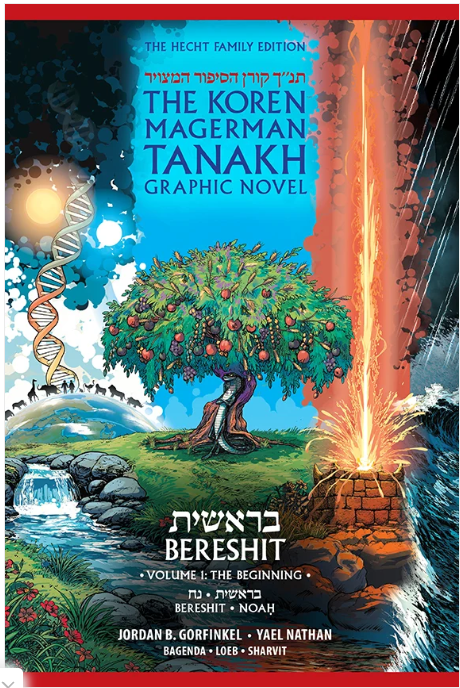
There is a visual treat, however, on virtually every page of The Koren Magerman Tanakh Graphic Novel Bereshit Volume 1: The Beginning, a newly-released comic book version of the Book of Genesis that takes the story from Creation to the building of the Tower of Babel. This volume embeds the full texts of the Torah’s first chapters in both Hebrew and English into dramatic and often dazzling pages of comic book art.
The complete Book of Genesis in comic book form was brilliantly accomplished by underground comics artist Robert Crumb, who in 2009 published what might be the masterpiece of his strange and prolific career. Crumb’s black and white drawings and hand-lettering of Robert Alter’s translation features on its cover the immortal disclaimer that should be on every edition of Genesis – “Adult Supervision Recommended for Minors” – yet the famously provocative artist was respectful of the stories and had clearly studied the text’s meaning(s) quite sensitively. To be sure, Crumb portrayed the scenes of wonder with great imagination, but he was primarily interested in the humans of Genesis, to the point where he drew at least one portrait of each personage mentioned in the book, no matter how obscure. For all its visual sophistication, Crumb’s earthy Book of Genesis was foremost a work of astounding psychological acuity.
In contrast, the Koren Bereshit uses the full capabilities of the graphic novel medium to convey the purely phantasmagorical elements of the narrative – the six days of creation, the Garden of Eden, angels, Nephilim, celestial realms, Noah’s Ark, and the Flood and its aftermath. The editorial director of this version is Jordan B. Gorfinkel, the longtime editor/director of the Batman franchise for DC Comics, and it’s amusing to see him credited as “creator and writer” of Bereshit given that the text is the original Hebrew and a scrupulous, scholarly English translation. But the storytelling is a product of his vision and imagination, executed by a talented team of graphic artists that includes Israeli illustrator Yael Nathan. The illustrations capture the fantasy elements that, no matter the sanctity and religious import of the Book of Genesis, remain an essential part to the narrative. There’s a reason that filmed versions Biblical stories are presented as epic spectaculars – the stories are genuinely spectacular. Living in the 20th and 21st centuries, we are accustomed to illustration and moving images – this version of Bereshit connects to the kind cosmological wonder and awe the words were intended to evoke in Iron Age Israelites millennia ago.
One image depicts the creation of mankind – for me, it evokes the art of The Watchmen and Marvel Comics’ classic Dr. Strange comics from the 1960s. The Planet Earth of Bereshit is a world roiling with supernatural energies where strange things are happening and powers beyond reason interact with material reality. For example, Adam and Eve living in the Garden of Eden are first presented as pure energy until the Fall, when they morph into physical human beings – one of the really smart touches of Gorfinkel’s storytelling. In contrast with Robert Crumb’s angsty Children of Israel, the humans in Bereshit are visually integrated into the mystic. The pages of the book explode with action, movement, and (most impactfully) color. If Crumb was most interested in human psychology, this Bereshit portrays the uncanniness of creation and strange landscape the familiar characters of the Bible inhabited.
So how does Bereshit fare as Torah in its most literal sense – “teaching”? I think it is an excellent way to learn Torah, whether as an introduction for a young person or for an adult who may be a lifelong student of the text. The words are all there in both Hebrew and English and the illustrations provide a kind of midrash for the Book of Genesis. Plus, they are mindful of observant readers' sensibilities - for example, while Robert Crumb draws a grey-bearded Jehovah in his book; no such image of God appears in Bereshit. The images and format devised by Jordan Gorfinkel and his team may help one have a better literal understand what is going on in the text, but more significantly, this presentation opens up more of the multitudes of meanings and imaginative possibilities the Book of Genesis contains. They have done a thoughtful and imaginative job in retelling this foundational book of our culture and I very much look forward to seeing the next volumes in this series.
The Koren Magerman Tanakh Graphic Novel Bereshit Volume 1: The Beginning is available on korenpub.com and at other online booksellers for $24.95. Our readers wintering down in Florida may also be interested in checking out the Koren Jerusalem Publishers & Booksellers bookstore in Boca Raton (at the Fountains Center, 7300 W. Camino Real, Suite 103). The image shows the book's cover.