
Award-winning filmmaker Abby Ginzberg brings her documentary Labors of Love: The Life and Legacy of Henrietta Szold to the BJFF
By Carol Goodman Kaufman / Special to the BJV
Abby Ginzberg is an American independent documentary film director and producer and founder of Ginzberg Productions. She will be in the Berkshires on Monday, July 20, when her latest film, Labors of Love: The Life and Legacy of Henrietta Szold, is featured at the Berkshire Jewish Film Festival.
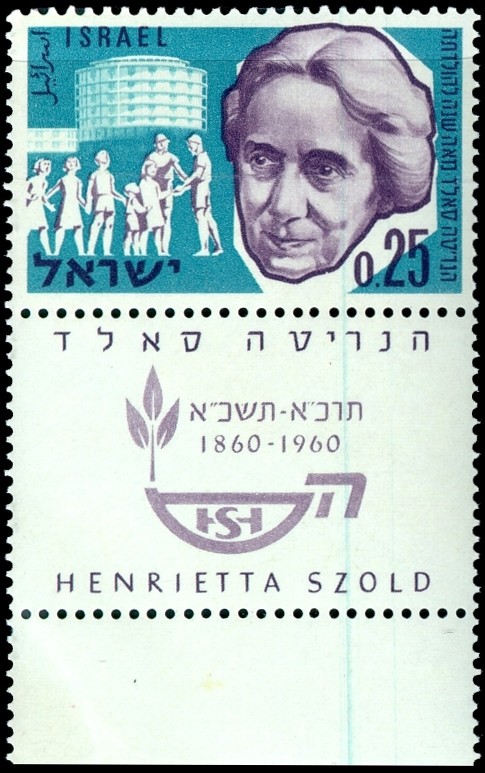
In 1912, Szold founded Hadassah, The Women's Zionist Organization of America, in New York City. In 1933, she immigrated to Eretz Israel and helped run Youth Aliyah, an organization that rescued 30,000 Jewish children from Nazi Europe. In October 1934, Szold laid the cornerstone of the new Rothschild-Hadassah-University Hospital on Mount Scopus. She died in 1945 at the age of 84.
Since starting to make films in 1983, Abby Ginzberg has made many films about discrimination and the legal profession. Ginzberg has won many awards for her work, among them the NAACP Image Award for Best Documentary for Barbara Lee: Speaking Truth to Power; the Peabody Award, for Soft Vengeance: Albie Sachs and the New South Africa; and has twice has won the American Bar Association’s Silver Gavel Award, for Soul of Justice: Thelton, and for Doing Justice: The Life and Trials of Arthur Kinoy.
Hadassah Berkshire Hills will host a desert reception before the film in honor of Director Abby Ginzberg at 2:30 p.m. for ticket holders. Email [email protected] for more information.
Ahead of her appearance, the Berkshire Jewish Voice had the opportunity to talk with her.
The BJV Interview: Abby Ginzberg
I understand that you went to law school. How did you come to film production from the law? And did your background in the law influence the films you’ve chosen to make?
I was working at the time for the state of California doing enforcement. They were about to kill OSHA [Occupational Safety and Health Administration]. I felt like I’m going to keep doing the same cases over and over. This is not for me. I’ve got to figure out another way to engage with the public. I felt like the stories were important, but I was talking to a judge or a jury at the time.
I got my start as a producer for worker training films, so by the time I decided to start doing my documentaries, I had enough of a reputation as somebody who knew what she was doing. I could raise money, because that was always the key. My very first film was civil rights lawyer Arthur Kanoy. My next film was about a federal judge Nick Felton Henderson, and my third was about the first Latino appointed to the California Supreme Court. What is the through-line for all the films that I’ve done? They are about people who are not well known. They may have lived through times that were well known and worked with people like Martin Luther King and Caesar Chavez, but you’ve never heard their names. As a result of that, I feel like I’ve introduced them to people who will be inspired by them. Their profiles are elevated as result of having a documentary made about them.
There’s also a social justice theme going on, both in those films and with Labors of Love.
Yes, I was trying to connect the earlier films with Henrietta. She was all about justice. I mean, she was brought up to think that she would be helping some scholar translate his work, which is what she did in the early half of her life. But she was capable of doing so much more.
In my films there’s always a moment in the person’s history that stands out. Everybody has a defining moment where their lives could’ve ended, or could’ve tanked, or something terrible could’ve happened. And it did for Henrietta. It was not a guarantee that she was going to be able to overcome her depression, her misery, when she was rejected. The fact is that she gets out under it with that trip to Palestine with her mother.
Why are you doing Henrietta Szold’s story now?
I wasn’t sure what Henrietta was like. Twenty years ago, this story was just not talking to me. Then I turned 70 and suddenly I identified with her as an older woman still active, still caring about the world, and still trying to figure out how to make the world a better place.
But it required me getting up to my shoulders in her until I knew that I had a story. But things didn’t just fall into place. Some of it didn’t work. We had to go back to the drawing board. We spent the time and took the care. We did try to get the story right. For example, I wanted to give the (Youth Aliyah survivors) a chance to tell me their story, as long as it connected in one way or another to Henrietta.
You have a personal relationship with the story of Henrietta Szold, don’t you? Your grandfather on one side was Louis Ginzberg, the very man who broke Henrietta’s heart. And your grandmother on the other side was Zip Szold, Henrietta’s sister.
I am sure that there was some discussion about a Ginzberg finally marrying a Szold among the people who knew the story, but it wasn’t widely known until much later when my father wrote about it and Baila Round Shargel published her diaries. It became kind of a big scandal.
Where did you do your research?
The Center for Jewish history in the AHS American Jewish Historical Society and the Schlesinger Library at Harvard were two of the main ones. The Central Zionist Archive in Jerusalem has all of her stuff from Palestine. Normally I hire people, but this time I just knew I had to see for myself, so I did my own archival research.
I spent two very long days at Meir Shfeyah (youth village). We got a lot of very good stuff. But my lack of Hebrew was actually an obstacle. I do not speak a word, so the interviews that I conducted in Hebrew were problematic in terms of being able to really be sure what the people were saying.
(Every Youth Aliyah group) that came over made a scrapbook for her of their time on kibbutz or in the villages. They were beautiful and handwritten, all thanking her for bringing them here for giving them a new life. It’s just pages and pages of gratitude. There are 20 boxes so that was a huge archive as well. Most of the movie footage came through the Spielberg Archive in Israel and the Jerusalem Cinematheque. They have footage of early day pre-state Palestine.
The good news is that because various books have been written and had relied heavily on the written archives, if I was looking for something specific, I had an idea of where to look for it. The archives were very helpful because they put you back in that period of time so you get to sort what was the correspondence like, who was she writing to and who was writing to her? You can’t get that from book.
The archivists were very helpful. There’s footage of Henrietta at the boat, welcoming the kids to Palestine. All that stuff is invaluable. There’s a lot of paperwork that was in these archives that I didn’t rely on because it was really more appropriate for a book than for a movie.
The New York Times covered her in a way that they never would today. It’s interesting that she was a character for them. I mean it’s not a mistake that they gave her a full obituary because they had been following her as an American in Palestine. It wasn’t on the front page, but every time anything happened it was somewhere.
Did you leave out anything?
There are some things that I could’ve talked about a little bit more, such as the numbers of kids that she was hoping to be able to bring to Palestine from places like Belgium and France and Poland, but that would’ve been a little mini story.
Probably 30 years ago I asked a woman to join Hadassah. She sniffed at me and said, “I don’t join women’s organizations.” Do you think maybe the 2022 Supreme Court Dobbs decision might inspire women to get more involved with women’s organizations and issues?
We thought we took care of everything. The victories were permanent for all of us and we didn’t have to worry about it. Everybody seems so complacent now. I just feel like we’re in a moment of a wake-up call. We are going to have to fight again.
I understand you have a personal connection to the Berkshires.
Yes, this is a bit of a homecoming in terms of bringing this film to the Berkshires. I have a lot of cousins here. I felt the same way bringing it to New York and Baltimore, to places where either Henrietta or I have strong connections. I’m hoping people will come out and learn about Henrietta.
I’ve seen the film already and I plan to see it again. It is absolutely wonderful, so I hope you get a huge audience.