
By Carol Goodman Kaufman / Special to the BJV
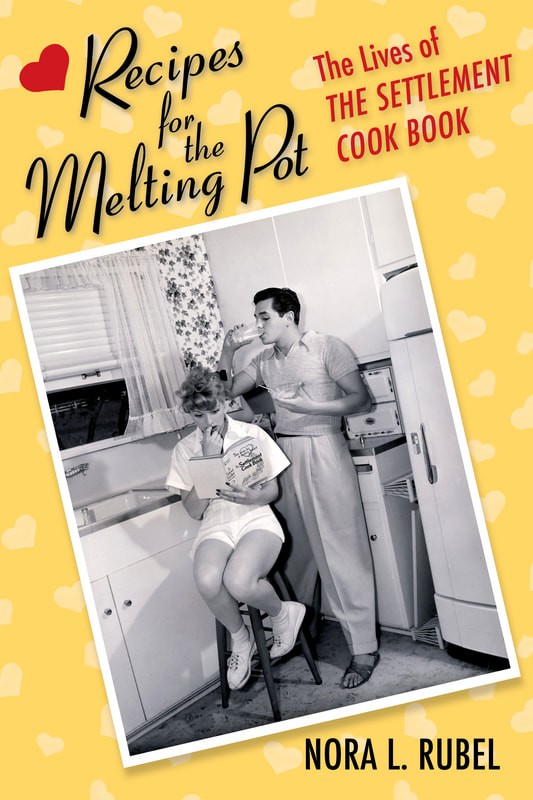
Despite its title, Nora L. Rubel’s new book, Recipes for the Melting Pot: The Lives of the Settlement Cook Book (Columbia University Press) is not a cookbook. While several recipes do appear in its pages, with 27 pages of references, this book is more a heavily researched academic treatise than simply a fond look at an iconic piece of Americana. It features chapters with such headings as “Dietary Reform as Moral Identity” and “For the Defense of Our Own Nationality.”
An avid collector of cookbooks, I have found that those produced by schools, sisterhoods, and charities tend to contain recipes with easily obtainable ingredients. In fact, many of my family’s favorite dishes are from recipes in the Our Best cookbooks produced by the Jewish women’s organizations in Pittsfield. That is decidedly not the case for many written by famous chefs that call for exotic ingredients and dozens of steps to completion.
But it is the history of The Settlement Cook Book that captured my heart. The quaintly titled The Way to a Man’s Heart of 1901 was originally a simple pamphlet used as a fundraiser for the settlement house in Milwaukee. Rubel writes that it was aimed at two distinct audiences: The well-off members of the volunteer corps and Milwaukee community who could afford to buy the book, and the immigrants themselves.
The dynamo behind the project was Elizabeth “Lizzie” Black Kander. Kander taught cooking to new immigrants with the aim of acculturation into America, but because cookbooks available at the time featured “American” food, they weren’t relevant to large waves of Italian and Jewish immigrants who came to our shores. So, she adapted dishes her students would recognize to include available ingredients.
With the goal of “culinary pluralism,” Kander included dishes of many ethnic groups, with recipes ranging from Ashkenazi gefilte fish to Anglo-Indian mulligatawny to Irish O’Brien potatoes.
Because the classes were held in a synagogue kitchen, every recipe in early cookbooks was kosher. Later editions included treif, such as oyster cocktail.
The Settlement Cook Book wasn’t just about the recipes. It also include sections on the rules for setting a table, dining etiquette, and hygiene.
Immediately upon ratification of the 21st amendment, the 1933 cookbook came with the subtitle 'The Repeal Edition.' For the first time, the committee included recipes for cocktails (e.g. mint juleps, gin fizzes), reinforcing the need to appeal to a moneyed audience, not just poor immigrants.
Aside from the few actual recipes, Recipes for the Melting Pot is sprinkled with advertisements, articles, and photographs. My favorite illustration is the newspaper ad from the Goldblatt Brothers department store. The Chicago-based chain offered a sale on several classic texts, including Webster’s Unabridged Dictionary, The Complete Works of Shakespeare, The Bible (King James version) — and The Settlement Cook Book.
The cookbook was so popular that, according to a study done at the University of Rochester, more than two million copies have been sold since its first printing in 1901.
The highlight for me in reading Recipes for the Melting Pot was finding a piece of my own family history. My parents were young and poor when they married in 1938. Their circumstances were such that the marriage ceremony took place in the house and my father baked the wedding cake. I had always wondered why it was a fruit cake he made, not the popular tiered construction with white frosting and intricate design. And then, in the pages of Recipes for a Melting Pot, I found a recipe for “Fruit or Wedding Cake” from the 1915 edition. My Bubbie and Zayde Goodman married in 1915. I’ll wager that the cookbook was a wedding gift to them, and I’ll also bet that’s where Dad found the recipe for it.
While I would love to include the recipe for this cake, with its over-ten pounds of ingredients, I don’t have a cake pan large enough to prepare it. So, instead:
Liberty Candy
From the 1915 edition
Ingredients:
2 cups seeded raisins
¼ cup honey
1 cup nut meats (Brazil nuts good)
Directions:
Grind nut meats and raisins in food chopper.
Mix with honey.
Pack under a weight for twenty-four hours.
Cut into small squares.
Roll well in granulated sugar.
Will keep well packed in layers between paraffin papers.
Editor's Note: Author Nora Rubel will present a program for Federation in April 2027. More details in a future issue of the BJV.
Carol Goodman Kaufman, has just published her second mystery book, Crak, Bam, Dead: Mah Jong Mayhem (Next Chapter Press). The collection of cozy mystery short stories features food writer/ aspiring investigative reporter Kiki Coben and her Mah Jong group as they follow clues from a “Black Widow” murder at sea to a suspicious death at a senior home charity event. Armed with a curious mind and her formidable group of friends, Kiki is ready to prove that the only thing you need to catch a killer is persistence – and maybe just a little bit of luck.