
By Howie Stier / Special to the BJV
JERUSALEM (10/7/2026) – At first known by the military term Cherevot Barzel, the Hebrew designation for 10/7/2023 evolved – first into the poetic “Ha’Shabbat Shachor” (Black Saturday) and now, on the third anniversary of the Hamas invasion and massacre, the accepted appellation is Ha’Shevah B’October.
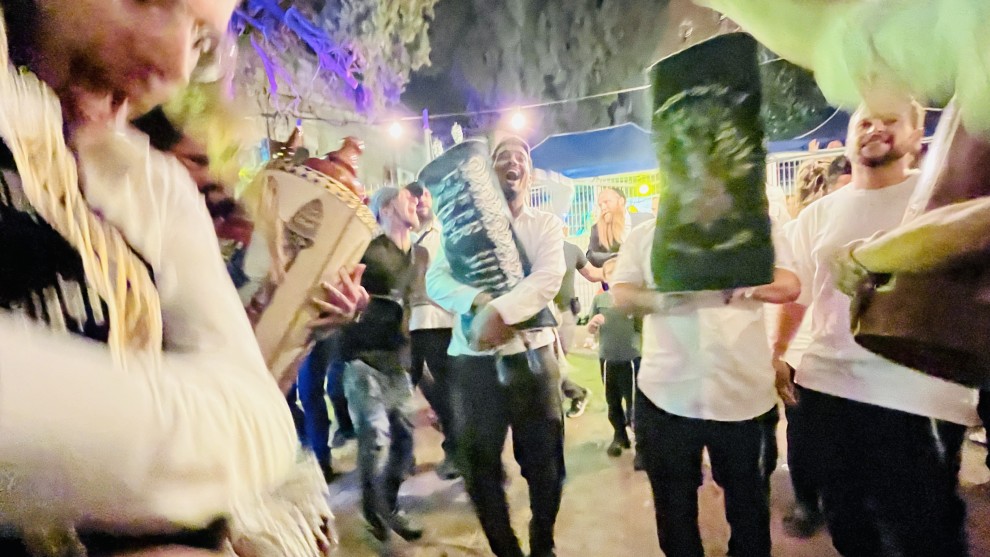
Today in Jerusalem, shops are closing early. The usual Israel Pop tunes are not broadcast from bars in the Shuk. Solemnity is palpable. But in a corner of Nachlaot, a 19th century neighborhood that’s a warren of low-slung stone and cast iron, there’s an anomaly. An unassuming man in frum attire stands aside a digital era boom box, blasting Chassidic niggunim. Passersby are baffled, unaware he is the vanguard of a Haknassat Torah – a celebration of a newly-finished Sefer Torah scroll. This is how Beis Hashem, a sprawling shul/yeshivah and social center, is acknowledging the day.
The Torah and entourage arrive. A band strikes up, piano and violin and horns, and a pair of chazzanim go through both the Ashkenazi and Sephardi repertoire. The Rabbi orders the aron kodesh emptied and six scrolls join the frenzied dancing.
Dancing are Chassidim of all stripes clad in black hats with brims both up and down, Na Na Nachman tasseled kippahs, white shirted yeshivah bocherim, and (curiously) a crew of Israeli stoners, all streetwear and dreadlocks. A couple of them are embraced by the Rav – he grabs a mic and sings with them the Karlin Chassid niggun to “Lavo El Hamelech” with them in the spotlight. I ask a Chassid next to me, “Why these guys? They couldn’t bother with yarmulkes and are given the schus (honor) of carrying the Torah?” He claps back in a heartbeat: “Don’t judge a fellow Jew until you reach his place, says the Alter Rebbe,” Rabbi Shneur Zalman of Liadi, the founder of Chabad, whose Tanya explains that if you don’t know someone’s personal struggle, you can’t judge. These two, it turns out, are survivors of the Nova Festival.
I am instantly humbled. Beis Hashem reaches out to just this type of Jew, many from observant homes who went off ha’derech (the path) and who struggle with dependency and now the trauma of war.
Among all murderous rampages targeting Israeli civilians in villages adjacent to Gaza, the Nova outdoor trance music gathering incurred the largest number of casualties, and Nachlaot is home to many devotees of the genre. And so the neighborhood was hard hit by Ha’Shevah B’October. Eitan Mor, now 27, volunteered to be a security guard at the festival and was taken hostage by Palestinians. He survived 738 days in captivity, and was released on October 13, 2025, on Hoshana Rabbah. His chaverim, however, didn’t return. And this Sefer Torah was written in their memory.
The ‘Succah of Shalom,' an expansive permanent structure at Beis Hashem where during the day Rabbi Nachman of Breslov's Chassidic wisdom is pored over, is tonight transformed into a white linen set dining hall. A platoon of waiters file through the tablescape sequentially serving platters of fish, meat and kubeh – Jerusalem’s ubiquitous Iraqi Jewish dumplings. I watch the servers hoisting trays overhead move on past a mechitzah into the nashim (women’s) section. And amid women in the height of multi-layered Bnei Brak fashion, many standing aside baby carriages and flaunting colorful tichlech (head coverings), there are the immodestly dressed young Israeli hipsters in jeans, neon-dyed hair, and tattoos. They too are the Nova survivors, witnesses to the killing, hunting, kidnapping of Jews, the sounds and sights of which will live with them the rest of their days. But today, taking in the dancing from windows in the mechitzah, they are b'simcha.
There are no long speeches, no podium for a shul president to expound from. Just a short acknowledgment and the music pumps again, the dancing continuing until the time for Tikkun Chatzot (‘the Midnight Rite,’ a nightly kabbalistic prayer of mourning for the Beit HaMikdash). A Beis Hashem habitué shapes up late.
Pesach Fogelman eschews food, dancing. He takes in the scene and looks for a minyan to daven Ma’ariv. “I’m numb today,” the retired accountant tells me. Of the trance music aficionados, he says, shaking his head in compassion for what they endured: “I see the bocherim, sitting on the steps near the shul at the end of Giv’on Street near their shul before Shekiyah (sunset), lighting up a joint. Sometimes I linger.”
He adds: “I was onetime, long ago, a liberal,” but that years of living in Israel moderated his outlook. “I was shouting at the radio when Vivian Silver was interviewed,” he says of the pro-Palestinian activist and Kibbutz Be’eri resident, who spoke to a reporter by telephone from her home’s safe room while the October 7 attack was in progress. Although at first it was assumed that she had been taken as a hostage, weeks later her torched remains were identified only by DNA. “When they slaughtered her, what little ember of liberalism that remained harbored in this poor heart of mine, died out.”
There’s a tzadik at my shul in the Berkshires, big donor, and given an opportunity to speak to the kohel never fails to mention “I left (a previous shul) because it was too cliquey.” In the embrace of this glorious mosaic of Yidden, I can appreciate how profound it is that there are no cliques here, not on this day of national loss anyhow.
The festivities continue well into the night. It’s past the time Tikkun Chatzot when I hit my bed and still sounds of niggunim echo through the stone walled streets.