
By Albert Stern / BJV Editor
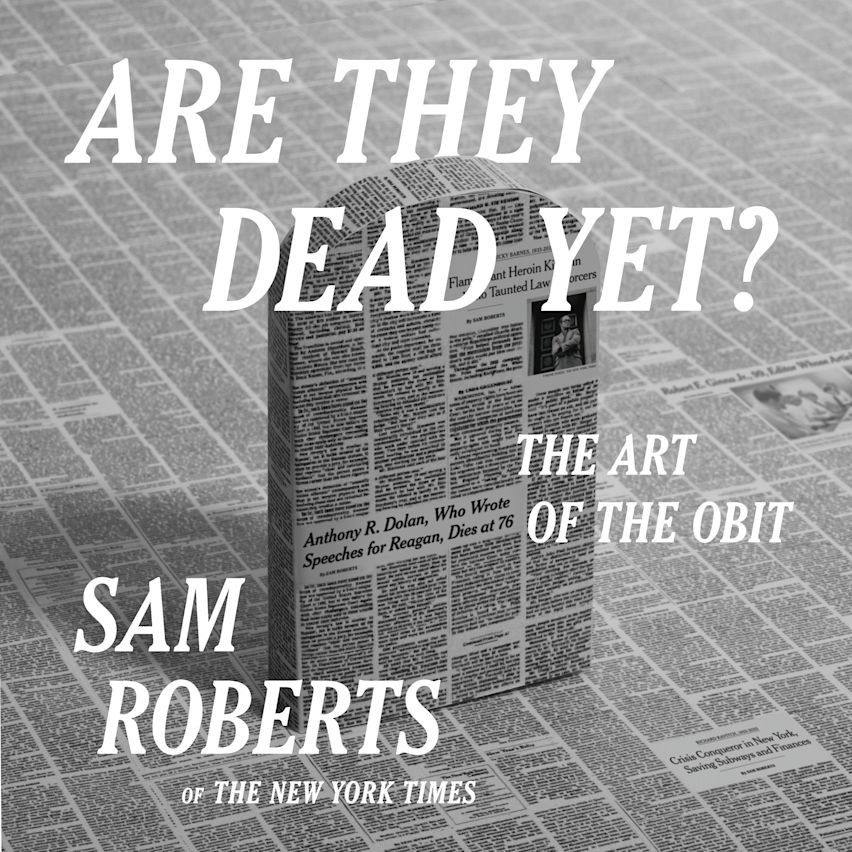
“If journalism in general is the first draft of history,” writes Sam Roberts, “obituaries are the clincher. That makes them more challenging to research and to write than any other category of news gathering I’ve encountered in more than fifty years of reporting.” Despite the image conveyed in fiction and films of the obit desk being a dead end for washed up or inept reporters, Roberts shares that “reporters and even editors at the Times queue up to be enlisted as obit writers.” In 2026, he points out, the Times had nine reporters assigned to its Obit Desk.
The essential point that Roberts demonstrates in his utterly winning new book, Are They Dead Yet? is that an obituary is not about death, but rather about life. “They are not necrology,” he writes. “They are not eulogy. They mention the word died only once. Even the derivation of the word – from the Latin obire – obliquely suggests not only mortality but a going forth, a rite of passage.” In the book’s prologue and sixteen fast-moving chapters – each one chockablock with surprising information – Roberts examines different aspects of the history and meaning of obituaries.
Moreover, there are more laugh-out-loud anecdotes or insights than one might expect going in to a book about the demised. I wouldn’t want to steal Roberts’s thunder by citing the funniest, but since I enjoy Bette Davis stories, I’ll share the one about Times reporter Albin Krebs, who was ostensibly interviewing the actress about a made-for-TV movie, but who asked her such broad questions about her life that she caught on that he had an ulterior motive. As Roberts relates: “[S]he said, ‘By any chance are you interviewing me for my obituary?’ When Krebs fessed up, Davis withdrew her offer of tea, disappeared into the kitchen, and returned with a shaker of martinis.”
And there’s something (and usually more than one thing) just as amusing on every page. Are They Dead Yet? is intelligently conceived and masterfully executed by a true pro – it’s easily the most entertaining book I’ve read in some time. The BJV spoke with Sam Roberts in August. Our conversation has been edited for length and clarity.
The BJV Interview: Sam Roberts
I want to start at the term “obituarize.” And when I first read it in your book, it seemed to me such an unusual word that I wondered if you coined it, but I guess not. Is that how people in the business use it – “I obituarized Jimmy Carter today”?
No, not really. I think that's kind of a technical term you'd find in a dictionary. But most people say we write obituaries. You know, as I said in the book, I come from a culture of denial of death. [Note: Roberts describes himself as a necrophobic youth coming of age in the years after World War II in the then-Jewish enclave of Brownsville in Brooklyn.] So when I was asked to do this about a decade ago, I was none too pleased. But then I realized, you know, of course, obituaries are not about death at all. They're about people's lives. The one thing I learned in doing this over 10 years and writing some 1,500 obituaries is that there really are no ordinary lives, that everyone has something that he or she in his own way contributes, is either transformational or emblematic of some sort of transformation. And we can learn lessons about life and death from all of these people. I've certainly learned a lot. People say to me, well, isn't it depressing to write about death all the time? I say, first of all, you're not writing about death, you're writing mini-biographies about people's lives. Secondly, if anything depresses me, it's how much more they've accomplished than I have. That on some level ought to be an inspiration for me and everyone else who reads what obituarists write every day.
What did you learn about writing a good obituary that had not been apparent to you when you first sat down with the assignment?
I found there's a lot more flexibility in it. It's not quite the same as writing a judgmental biography, but you do have to make judgments about who gets an obituary. Secondly, how do you put in context and perspective the various parts of someone's life in the trajectory of their life? If they made a mistake in their youth, if they took a wrong turn, if they did something enormously successful and never did anything again. How do you put that in some sort of context when you're looking in an obituary at an entire life, not an incident, not a news event? I found that I needed to make judgments like that. I also start off with the goal that I mentioned in the book about trying to find the “Rosebud” moment. What was it in that person's life that elevated them into the status of deserving, if you will, a New York Times obituary? What was the epiphany? Who was the teacher who set them on a different course? Or the clergyman or the neighbor or the sibling or the event that suddenly turned them into the kind of person who would accomplish what became worthy of a Times obituary?
How much of a by-committee process is the decision to publish an obituary in the Times?
They're usually self-evident. The problem is that about 150,000 people die every day, and we have room for about 3 or 4 obituaries. So, it's a very subjective judgment, and it's very hard to defend to someone who says, well, wait a minute, you had this big obituary about this mass murderer, but you left out my father, who was a country doctor who cured all sorts of people and helped them. You can't explain away something like that. It's a vetting process that starts off with a very long list of people who are potential candidates, and then editors and occasionally reporters look into them.
Now, I've suggested people who've been turned down, and I've gone back to the editors and said, here's why I think this person deserves an obituary. And, you know, the editors are persuadable. It's a very flexible process. There's no ritual formula to it. Obviously, there's been more of an effort to include women and members of minority groups who clearly have been overlooked in the past. I can say it's really on merit and defining merit as someone who is important and intrinsically interesting, someone who made a difference.
Your book is chock-full of anecdotes, stories, information. What was your process in collecting all that information? When you started, did you think about keeping files of obituary-related stuff that you could pull together later?
There wasn't a feeling when I started doing this about a decade ago for the Times that I was going to write a book. I mean, I didn't want to write anything more about dead people than I had to. But when I began to explain to people, including my editors at Bloomsbury, what I did every day for a living, they said, it’s pretty fascinating that you're delving into people [lives], sometimes with interviews for advanced obituaries of people who are, you know, the “nearly departed,” as we call them. You get a chance to interview people about what was important in their lives. You get a chance to make snap judgments, if you will, on what people contributed. These are not, again, biographies. They're not histories. They're something that comes out within a day or a couple of days after the person died. You've got to be very careful in what you're saying and what judgments you make, and also understand that those judgments change over time.
I guess what I'm also asking is just how did you store the information that you kept in the book?
That would have been much too much organized for me. It's something I should have done, no doubt. Frankly, I would much rather do the research than the writing, because it satisfies my curiosity and I'm not that facile a writer. But you just accumulate everything you possibly can. You read a book about something and there's one little line about someone and then you go back and do more research. It comes down, I guess, to curiosity. Once I decided I was writing this book, I began to keep notes as much as possible and then try in my own head to break the narrative into chapter headings. A lot of it is serendipitous – just finding things, stumbling across things, grasping things, asking about things.
It would seem that writing an obituary for a great person would be straightforward, although being selective about what information to include would be a difficult part of the process. But then there's a person like the one you write about who came up with the Alka-Seltzer advertisements in the 1960s. First of all, how do you find a detail like that, if that perhaps was the only thing of note that person did? And then what kind of obituary is more fun for you to write – one for a great personage, or for the guy who came up with “plop plop fizz fizz”?
Thomas Carlyle, advocated the great man or great person theory of history. But then he went on to say, well, who was greater, Hannibal, who moved his army across the Alps, or some anonymous guy who invented the spade? To me, most interesting are the people who might well be important, but who I still had never heard of. I have to say, and I feel a little guilty about this, that when I started out half a century ago writing for the New York Daily News, it was a lot tougher doing research than it is with the availability of the internet. If I wanted to find out someone's phone number out of town, I had to schlep over to the New York Public Library and look at a phone book. Now, because of the internet, you have access to video interviews with people, you have access to much of their written material. You have access to oral histories that they've conducted or compiled, and it makes the obituary writing so much richer because you have that so-much-larger pool of information.
I'm obsessive about gathering information, which is why I'm usually behind deadline on books, something you can't be writing for the daily newspaper. But there is so much more material out there that you can grasp and accumulate that tells what Anne Rowe, obituary editor of The Economist, says is the soul of the person. It's not just the dates and the chronology of where they went to school and what kind of degree they got, but what their view of the world was and how that view was formed and how that view may have changed over time.
I enjoyed your story of the entrepreneur who invented the cheerleading industry and many of its conventions, and made millions. Who would have thought that one guy was a mastermind behind cheerleading?
Some might well say, what difference does that really make about society? But it says something about what we do every day. It says something about the Super Bowl halftime show, what we value, what we are interested in, what we pay money for, what we learn from. So you know, all of these things which infinitesimally may not seem that significant, add up to what our society is all about, something about who we are as people.
Early in the book, you write: “Especially in small towns and mid-sized cities, local newspaper obituaries bind one generation to the next by recalling where the deceased were, went to school, and whom they married, who survived. The obits provide the frames from a moving picture of continuity and narrative of cohesion.” When I first moved out here and started reading the local paper, I was surprised that the obituary pages took up so much space. And they usually conveyed something mundane like, “She enjoyed crocheting and was always a hit at the Italian American Club potlucks with her famous baked penne.” Tell me a little bit about what you learned about how obituaries play a role in smaller town consciousness.
It's so unfortunate that the coverage of local news has declined so much, whether it's in New York City or whether it's in the Berkshires or anywhere else. Part of it is a question of economics, of course. I think we lose something in our ethos, in our values, in our sense of history and context when we don't commemorate, in some way, the people whom we have lost. When 9/11 occurred, the Times did something totally out of character - we began those portraits of grief of ordinary people, hundreds and hundreds and hundreds of ordinary people. The essence of it was: who would you miss more, your mayor or your mailman? Those obscure, so-called ordinary people have a big impact on our lives and, vice versa, we do on theirs.
I think people are interested in things like the penne that so-and-so used to make and the tomato sauce or the gefilte fish or whatever it was. This says a lot about people. It says why we remember them, why we consider them important, why we memorialize them, why we care about them still. And it's something that gets passed down from generation to generation. People – and it’s especially a small-town phenomenon – clip out the obituaries and save them as keepsakes, as mementos, because that is kind of the last word on a person's life. Frankly, that to me is an awesome responsibility. It may sound a little immodest, but you are assessing someone's life and you know – they're not going to get too many other chances to be written about. You've got to be as careful and as full and as fair as you possibly can. That to me is the biggest challenge.